Beware of Scammers!

Photo credit: angel_shark / Foter.com / CC BY-NC-SA

Photo credit: angel_shark / Foter.com / CC BY-NC-SA

Even though most people are good-hearted and honest, there is the possibility that you will be contacted by dishonest reward-seekers and scammers when your dog is missing. Just last week, an owner of a lost dog emailed Lost Dogs Illinois (LDI) saying someone had contacted them from out of state, using a disposable calling card, leaving no address or name and ask to be paid a reward.  The owner was distraught.  Did we think they had their dog?  What can they do? Losing a dog is a heartbreaking and we, at LDI, cannot understand why people would be so cruel to defraud lost dog owners.  In an article last year, Better Business Bureau (BBB) published the most common scans and how to prevent them.

The Pay-Me-First Scam: The lost pet owner receives a phone call from a person claiming that they have the lost pet in their possession. This person asks that the reward money be sent to them before they return the pet. If the pet owner refuses, they will often threaten to hurt the pet in order to pressure the pet owner into sending money. Once the scammer receives the money, they are never heard from again.

The Truck Driver Scam: Someone claiming to be a long-haul truck driver tells you that he came across your pet while on his route. He then asks you to send him money so that he can send your pet back to you, or he may ask you to wire him money to board your pet until he can send your pet back with another truck driver who’s heading your way.

The Tag Team Scam: You receive a call from someone who says that they think they have your pet. After talking to you for a while and getting information about your pet, they apologize and say that they’re sorry, but it turns out that it’s not your pet after all. They then give all the information about your pet to a partner. This is a set-up — in a short time, the scammer uses the information received about your pet only to have a second person call and claim to have found your pet who will try collect any reward money in advance..

The Airline Ticket Scam: Someone calls and claims that your pet somehow ended up in another state. They ask you to send money for a kennel and an airline ticket in order for them to ship your pet back to you. Once the pet owner sends the money, the scammer walks away with it, leaving the owner without their pet and with less money in their bank account.

BBB provides the following tips to keep from falling victim to a pet loss scam:

1. If you get a call from someone who claims to be out-of-state, ask them for a phone number where you can call them back.

2. If a caller claims to have your pet in their possession, ask them to describe something about the pet that wouldn’t be visible in pictures which may have been posted.

3. Never wire money to anyone you don’t know.

4.  Report the scam to your local police.

So, we bet  you are wondering if the family found their dog?  Yes, they did.  A Good Samaritan had picked their dog up.  Because of the family’s heavy flyering in the area, they were reunited with their dog.   A Very Happy Reunion!

Probability VS. Possibility

Probability VS. Possibility

Photo courtesy of ponsuwan/Freedigitalphotos.net

Photo courtesy of ponsuwan/Freedigitalphotos.net

At Lost Dogs Illinois, we never say never.  We have had too many surprises and unlikely scenarios play out in the last few years.  But, that being said, we have learned a few things from the thousands of successful reunions that our organization and those of our sister sites have been involved with.

An owner that focuses the majority of their effort on what “probably” happened to their dog; rather than worrying about what “possibly” happened, is far more likely to have a quicker, more successful recovery.

Consider the weather. Is it possible for it to snow on any given day of the year in Illinois? Yes.  Is it probable? No.  So you can probably safely leave your parka at home in August.

Some examples pertaining to dogs:

  • A dog lost from a car accident that is not being pursued will probably stay within a 1/2 mile radius of where the accident occurred.
  • A small friendly dog lost in a populated area has probably been picked up, often very close to where they went missing from.  They can be taken to a shelter, stray holding facility or rescue; or kept, or rehomed.
  • A shy, fearful dog is probably still “out there” learning to live on their own and avoiding people.
  • A “dandelion”; common dogs that all look alike (eg. labrador retrievers)  are easily lost in the animal control/shelter system.

We have broken down our website articles to try to help you quickly “profile” your dog so that you can focus your efforts on probability. First; determine whether your dog has the risk factors of an elusive dog or an opportunistic dog.

Then read the corresponding articles from the Shy or Friendly categories on our website. Click on the categories on the right side of our webpage.

Our most likely “prediction” – most dogs are recovered because somebody that saw or knows something, saw a flyer or sign for the missing dog. Go door to door in the area that your dog was last seen and ask everybody if they have seen your dog. Use intersection signs to attract the attention of passing motorists.

Don’t delay! Your lost dog is depending on YOU to bring him safely home.

Reuniting Lost Dogs With Their Families – How Shelters Can Help

Patty, an Animal Control Officer at Winnebago County Animal Services in Rockford , Illinois checks the kennels for dogs matching the descriptions in the Lost Dog reports.

Patty, an Animal Control Officer at Winnebago County Animal Services in Rockford , Illinois checks the kennels for dogs matching the descriptions in the Lost Dog reports.

There are more lost dogs now than there have ever been.  Pet ownership is up and we, as a nation,  are saving more dogs, with many more people choosing adoption as their option. This is a great thing but it comes with its challenges. For many people, this is their first experience owning a shy, rescued dog. These dogs are often high flight risks and can quickly escape through a door or wiggle out of an ill-fitting collar, harness or slip lead.

Searching for a shy lost dog is expensive and time-consuming. Most shelters and rescues are obliged to help search for a dog that has gone missing from a newly adopted home, a foster home, their transport or their facility. Publicly funded shelters and stray-holding facilities are also obligated to proactively return lost pets to their owners, because they are taking taxpayer money to do it. Please read our series “Harnessing the Energy” on how rescues and shelters can organize teams of volunteers to help capture a lost dog.

But unfortunately, many shelters do not proactively help reunite lost pets. The average national Return to Owner (RTO) rate for dogs is 20%, for cats – a dismal 2%.  You only have to walk down the aisle of a shelter and read the kennel cards and see how many of the animals are listed as “stray” to realize the enormity of the problem.  If shelters could get more lost pets home, it would reduce shelter deaths and save taxpayer money.

Shelters that are introducing proactive programs (often entirely volunteer-run) are seeing their Return to Owner rates rise.  Some shelters are reporting RTO rates higher than 70% for dogs.

What can a shelter do to improve their Return to Owner rate and why would they want to?

Goodwill, positive press and donations are generated when an animal control agency or shelter takes a proactive approach to reuniting lost pets with their families. Heartwarming stories and photos (easily posted on Facebook) elevate the reputation of the facility from “dog catcher” to compassionate life-savers.

A shelter typically has two windows of opportunity to help people find their lost pet.

1. When a person who has lost a pet comes in or calls to file a report.

2. When “stray” dogs and cats are picked up and impounded at the facility.

There are different levels of staff and volunteer participation that can be utilized to help facilitate more reunions. Starting with just a few simple changes can make a difference!  Animal control officers should be encouraged to do field redemptions whenever possible.  Equip animal control officers with microchip scanners and laptops or smartphones. Getting lost pets home before they even enter the shelter system lessens the workload on the kennel staff, decreases overcrowding and illness,  and reduces euthanasia.

Volunteers and staff can be trained to implement many parts of an RTO program. Here are some ideas that have been successful:

Reuniting “Owned Strays” with their owner:

  • Scan every animal that is brought to your shelter for a microchip using “Best Microchip Procedures”.
  • Keep detailed records about where and when an animal was picked up and make this information available to the public.
  • Use a dedicated email address for lost and found reports. This will help keep these reports separate and out of the general email stream.  example: lostpets@abcanimalshelter.com
  • Keep detailed records of calls your facility receives from people who have lost a pet. Use an online reporting system also, so they can fill it out after hours. Request that they email or fax a picture and show the photo to your staff members and volunteers immediately after you receive them.
  • Have volunteers or staff members compare lost pet reports with the animals your facility is holding to see if any match. Store the reports and photos in a binder that is easily accessible to staff and volunteers.
  • Depending on volume, either set up a dedicated Facebook page or use albums on your  regular Facebook page to post pictures of lost pets that were brought to your facility. Allow the public to post as well.  Facebook allows other people to share the posts and many times reunions happen because a neighbor or friend recognizes the dog.  Websites are usually only viewed by the owner.  It is easy to train volunteers to maintain and moderate a Facebook page.
  • Set up an account with Helping Lost Pets.com, an international, map-based website that makes it easy for staff, owners, finders of dogs, volunteers and the general public to get involved in matching lost dogs with their owners. Here is an article on the HeLP system: http://lostdogsofamerica.org/helping-lost-pets-provides-one-national-website-for-all-missing-pets/
  • Post the same pictures on your website for those people that don’t have a Facebook account. Using the Helping Lost pets system will provide a “shareable” link to the photos to Facebook and Twitter.
  • Use a volunteer “greeter” that can help people that enter the facility looking for their pet.  This will lessen the workload of the front office staff. This volunteer should know what the requirements are and be able to easily communicate this with an owner (eg. proof of ownership, vaccination records). Have these printed out in both English and Spanish to give to the owners so lost pets can be reclaimed as quickly as possible.  Many pets are “abandoned at the shelter” because the reclaim fees are too high.  You always want to facilitate fast reunions to reduce this abandonment.
  • Negotiate and lower fees to reduce abandonment at the shelter. Authorize front desk staff members to negotiate fees. Many owners are embarrassed to ask or don’t know that the shelter will negotiate. Make it easy to reclaim a lost pet.
  • Have volunteers monitor other internet and community lost pets listings including Craigslist, community newspapers, Facebook pages and websites.
  • Trained volunteers can track down the owners of impounded pets with disconnected phone numbers or lacking current microchip information. Here is an article that will help: https://www.lostdogsillinois.org/how-to-trace-dead-end-microchips-and-tag-information-on-found-pets/
  • Mention whether a dog that is adoptable or impounded was brought to your shelter as a surrender or a stray.
  • Scan every animal in your shelter one last time before allowing him or her to be adopted or euthanized.

If the owner’s lost pet is not at the shelter, compassionate, customer-service oriented volunteers can be trained to assist the owner by doing the following things.  Extra assistance may be needed for elderly owners; owners without internet, computers or transportation; and those owners for whom English is a second language.

  • Assist the owner in filling out a lost pet report form. Explain to them how to “red flag” their missing pet with the microchip company and/or update information if it isn’t already done.
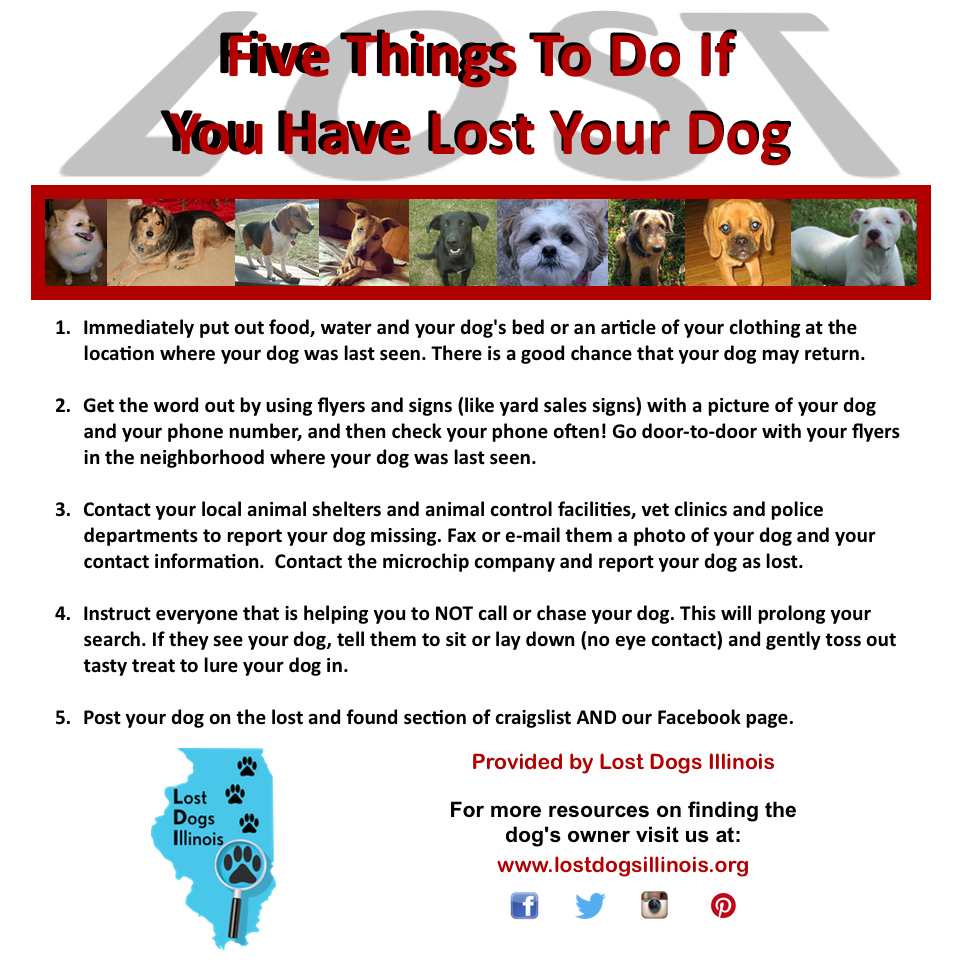
  • Provide them with our 5 Things Flyer in either English or Spanish. The 5 Things Flyers is good for both dogs and cats.
  • Provide them with an Lost Dogs Illinois business card if it is a dog. Our website has a lot of valuable information that can help them find their dog.  If it is a cat – provide them with the link to any Lost Cats or Lost Pets Facebook pages in your area as well as the catsinthebag.org and missingpetpartnership.org websites.
  • If they already have a flyer made – post it on the shelter bulletin board. Volunteers should keep the bulletin board tidy and up to date.  Date each flyer and then call owners after a certain number of days to do follow up and provide more support and assistance.
  • Develop a “pet detective” team  that can help owners  develop a strategic plan for finding their lost pets based on the circumstances regarding their disappearance, their breed, location, etc.
  • Provide trap rentals for the public.  Here is a series of articles on trapping: https://www.lostdogsillinois.org/humane-trapping-before-you-begin-part-9-in-a-series-2/

Shelters should be willing to dedicate a portion of their website to helpful advice for missing pets. May people lose their pets late at night and frantically look for information on the internet to help them with their search. Providing links to good information on your website will work for you even when your staff is busy or the office is closed. You will appear to be a “helpful” resource in the community even if people only accessed the information via your website.

At Lost Dogs Illinois, we are committed to helping reunite people with their lost dogs. Together with the help of shelters and stray-holding facilities we can make a difference. Please contact us at lostdogsil@gmail.com if we can be of assistance to offer training to shelter staff and/or volunteers. We have numerous power points for all components of our volunteer training that we would be happy to present.We would love to hear from you!

National Volunteer Week April 21 – 27, 2013

We want to thank our dedicated and compassionate volunteers who monitor our FB page; post lost/found dogs & reunions, maintain our website; follow up on lost/found dogs; monitor Craigslist, attend special events, provide IT and Twitter support, provide statistics, write articles and photo tips, and the list goes on. Without them this page and the website wouldn’t be possible. Thank You LDI Volunteers!

National Volunteer Week

Jump Starting Your Search For the Long-Lost Dog

Jump start

Your lost dog has been missing now for several weeks (or months) and your sightings and leads have fizzled out. Don’t despair.  It is never too late to jump-start the search for a long-lost dog.

This article is designed to give you some ideas for reigniting your search to give you a place to pick up again. Hopefully, you have read our other articles on shy lost dog search strategies and friendly lost dog search strategies. If not, please check the categories at the right that link to many more articles.  We also hope you have mapped all the sightings on a map, either a web-based map like Google Maps or a large-scale paper map.

Now, imagine you are a detective working on a cold case.  You may talk to 99 people who have not seen or heard anything.  You are looking for the ONE person who has.  Someone, somewhere has seen or knows something.   Be persistent and don’t give up. Even if they haven’t seen your dog, they may see your dog tomorrow. Putting a flyer in their hands ensures they will know who to call when they see him.

Look at your map and draw a circle in a one mile radius around the last confirmed sighting. Go back to the last confirmed place that your dog was seen and flyer heavily in a one mile radius. Don’t let false assumptions or geographic barriers deter you.  Don’t assume that your dog would NEVER have crossed the highway or the river or the lake. False assumptions will make you miss possible sightings and leads.

Make sure you have listed your dog with our partner, Pet FBI at www.petfbit.org so that his or information is maintained in a centralized, national database.  Talk to everybody! Put a flyer in their hands and ask them if they have seen your dog or if they think a dog may have been hanging around their house or farm. Did they see dog tracks under their bird feeder? Was their dog poop in their yard when it shouldn’t be there? Was their outdoor cat food disappearing faster than normal?

Visit EVERY place that serves food in the one mile radius. Don’t forget convenience stores and gas stations! Talk with the kitchen staff and management. Did anybody see a dog hanging out near the dumpsters? Did anybody notice dog tracks near the dumpsters in the winter? Did any restaurant patrons mention a dog hanging out in the parking lot? Did anybody see a similar looking dog being walked in their neighborhood?

Think about the demographics of the neighborhoods in the one mile radius.  Maybe you need to print some flyers in Spanish or another language? Or, maybe there are some older residents who don’t get out much to see signs and flyers but may have taken pity on your dog and fed him over the winter?  Think about the people that may not have seen or understood your first round of flyering.

Now is a great time to refresh your posters and intersection signs.  You may want to change the heading to STILL MISSING – so that people know that the search is still on. Think outside the box. Ask every business in the one mile radius if you can hang a flyer in their window and employee break room. Maybe your dog approached workers on their lunch break. Or maybe they saw him when they were driving to or from work.

If you don’t get any new leads in the one mile radius; you will need to expand your area. You may want to consider using  USPS Every Door Direct Mail.    Beware of some of the other lost pet mailing services that you will see advertised. Some of them are scams and do not reach the number of homes that they promise.

Refresh the memories of the animal control facilities, shelters, police departments, vet clinics and municipal offices in your county and surrounding counties. Send them fresh flyers.

Give a new flyer to postal workers, delivery drivers, school bus drivers and garbage truck drivers. Don’t forget pizza and sandwich delivery drivers also! They are out and about  in the evening, when your dog may be moving around, looking for food.

Check with your local Department of Transportation. Have they found any deceased dogs alongside the road? Or has a dog been spotted eating on a deer or other wildlife carcass?

Check with your local railroad companies to see if they have any reports of deceased dogs along the railroad tracks.  Lost dogs often use railroad tracks as a path of travel between their hiding places and food sources.  Deceased wildlife hit by trains also make a good food source for hungry lost dogs.

Repost your dog on Craigslist, Next-door and your local online classifieds. Consider taking out a print newspaper ad also. There are still many people without computers or the internet!

Remember, Never Give Up!  Re-energize and jump start the search for your missing dog.  Your dog is depending on you to bring him home.

Our tips, ideas and articles are based on information gathered from thousands of successful lost dog recoveries. Any advice or suggestions made by Lost Dogs of Wisconsin/Lost Dogs Illinois is not paid-for professional advice and should be taken at owner’s discretion.

1/22/2021

We Don’t Recommend Offering a Reward for Your Missing Dog

Money


Are rewards a good idea? Many lost dog articles in print and on the internet recommend offering a reward to increase the chance of getting your dog back. We don’t agree. We have based our opinion on thousands of successful recoveries. In this article we would like to explain our reasoning based on the three possible scenarios for your missing dog:

1.If your dog is shy; offering a reward does exactly what we DON’T want people to do.  It encourages people to chase your dog in order to get the reward. We have an eyewitness account of a woman chasing an extremely shy dog across a corn field with a ham sandwich because she wanted the reward money.   It could easily have had tragic consequences because she was chasing him directly towards a busy highway. Luckily the dog was recovered safely, but it took two more weeks and the dog had gone an additional twenty miles. This added extra expense and stress for the already stressed-out owners.

Your strategy with a shy dog should be to encourage the dog to “settle” into an area and relax.  Regular meals at a feeding station will allow the dog to return to a more domesticated state of mind and will give you the best opportunity to capture him.

2. If your lost dog has been picked up by a Good Samaritan, their motive will be to return the dog to a loving home. Even if they have already kept or rehomed your dog, they will feel guilty or be afraid they will be “ratted out” by their neighbors.   You can always offer them a small token of your appreciation for their time and trouble after you have your dog back safely.

Your strategy should be to file a police report immediately so that you have started the paper trail that may be necessary if your dog has been kept or rehomed.  You will also need to flyer very heavily and use intersection signs. Put a sign in front of your own house also! Keep checking your local shelters. Remember, the Good Samaritan is motivated to return your dog by seeing how much you miss him.

3. If your dog has been trulystolen (somebody broke into your car, residence or business with the intent of stealing your dog and/or other possessions) and you feel that their motive is greed; you still don’t need to put a reward on the flyer.  The thieves will be watching for your flyers and ads and will contact you to ask for a reward.  Make sure you have contacted the police and have them accompany you when you arrange to meet the thieves.

Offering a reward for a missing dog has these other detrimental effects:

1. It encourages scammers to contact you, who do not have your dog and may never even have seen your dog.  But they have seen your flyers and ads offering a reward. They might email you pictures that look like your dog; these may be photo shopped, or taken from your Facebook page.  The scammers will want to meet you at a location to exchange cash for your dog. Call the police immediately if you are approached by somebody that says they have your dog but you must give them money to get your dog back. Otherwise you will have no money and no dog.

2.  It makes it harder for the next person who loses their dog, especially if they can’t afford to offer a reward.  Rewards encourage scammers, thieves and dognapping.

3. It “legitimizes” dognapping and encourages people to hold out for a reward, perhaps even Good Samaritans.  Stealing a dog or keeping a dog that you have found is illegal. Extortion is illegal.  We need to keep emphasizing this in order for it to be taken seriously by law enforcement and the public.

The buck stops with you! Please don’t publicize a reward for your missing dog on your flyers and ads.   Let’s all work together to help more lost dogs get home safely.

Our tips, ideas and articles are based on information gathered from thousands of successful lost dog recoveries. Any advice or suggestions made by Lost Dogs of Wisconsin/Lost Dogs Illinois is not paid-for professional advice and should be taken at owner’s discretion.


Using Facebook to Maximum Potential

file000182909681


Lost Dogs Illinois was designed to help individual owners and finders of dogs who are keeping them in their homes while looking for the dog’s owner. We provide  postings, a website, tips and suggestions to help happy reunions happen. We are thrilled that the idea has taken off and has become so successful. We are often asked if we can post pictures of “strays” in shelters, veterinarian clinics, police departments  or other animal control or stray holding facilities. We would love to accommodate them all; but unfortunately this would defeat our purpose. When we “overpost” Facebook has a sneaky way of hiding our posts in our fan’s newsfeeds. This would also overwhelm our volunteers who generously give of their time to help lost dogs.

Instead, we encourage every shelter, vet clinic, police department or other agency that holds “strays” to develop their own Facebook page to help lost pets in their community. We will gladly share the link to the page and feature it on our website. We truly believe that with today’s technology and social media availability that it is the ethical responsibility of every animal control and stray holding facility in America to make sure that they are using all of the tools available to get lost pets back to their owners. Reuniting lost pets frees up kennel space for the truly needy animals and saves lives.

Why Are We All A-Twitter?

twitterFacebook is great!  It has helped us to connect and share our posts with over 32,000 Facebook fans in Illinois. Many of those fans re-share our posts and many lost dogs have been reunited with their owners.  But not everybody is on Facebook.  That is why we have branched out to include other social media sites in our toolbox.  Pinterest is a hot new social media site that we are on. Or, if you like your messages short, sweet and easily searchable; you can “follow” us on Twitter.

For efficiency, we have linked our Facebook account to our Twitter account so that our Facebook postings automatically are “tweeted”.  But Twitter requires that we keep our “tweets” to only 140 characters. So, we try to get all of the important information out about  lost or found dogs in the briefest way possible.  Then, if somebody sees a tweeted lost or found dog from their area, they can click on the link for more information.  Or, if the dog isn’t from their area, they can ignore it. Twitter also gives the account user the ability to “retweet” the posting to their followers. One retweet from an influential user (think celebrity or a media outlet like a newspaper or radio station) can result in our tweet going to thousands of people.

Did you know that you can search Twitter via hashtags? A hashtag is a word or phrase prefixed with the symbol #.  For instance if you want to see all of the dogs missing from the Springfield area – you can simply type #Springfield into the search box.  You will get our missing or found dogs but will also get all of the other news and information about Springfield.   Be aware, that there are other cities in America named Springfield, so you might get search results from those also.   If you want to see all of our missing and found dogs, regardless of location, you can follow our Twitterfeed at @LostDogsIL.

A note about hashtags:  They must be all one word to work.   Buffalo Grove must be typed #BuffaloGrove.  Capitalization isn’t important.  #buffalogrove would get you the same results in the Twitter search.  So, when you see our Facebook posts without spaces between the words and the # symbol in front, it isn’t because we can’t spell!  It’s because we are trying to maximize our exposure so that more lost dogs get home!

Thank you for “sharing”, “pinning” and “retweeting” our postings. You are saving lives!


Creating and Placing Effective Signs

Effective signsPosting signs is one of the most effective things you can do to get your lost dog back home.  But it’s important to realize that not all signs are created equally, meaning some are more effective than others.  If you follow the steps below, you will be successful at both creating effective signs and putting them in the appropriate locations.

  1. Purchase the following supplies if you don’t already have them:  seven colored foam poster boards that are at least 15” x 20”, rolls of clear and silver duct tape, a large Sharpie and scissors.
  2. Print one 8 ½” x 11” picture of your dog for each poster board.
  3. Write, “LOST DOG,” at the top of each poster board with your Sharpie.
  4. Tape a picture of your dog in the center of each poster board using clear duct tape, making sure to cover each picture entirely with clear duct tape or putting the picture into a ziploc gallon bag (w/opening at the bottom) to protect them from wet weather.
  5. Write a contact number below your dog’s picture.
  6. Waterproof your signs by covering their foam edges with clear duct tape.
  7. Put a sign in your yard so it can be seen easily by passers-by.
  8. Map a 3-mile area around the location where your dog went missing in the form of a hexagon.
  9. Secure signs at the intersections nearest to each point of the hexagon using your silver duct tape and scissors.
  10. Move your signs after each reported sighting of your dog by mapping a new 3-mile wide hexagon around the spot where your dog was most recently seen, and hanging signs at the intersections closest to each of the hexagon’s points.
  11. Last but not least, always make sure you have permission from the land owner before placing a sign, including city and county property.

Flyer, flyer and flyer some more!

Your friends and family members are eager to help you find your lost dog. They are willing to do whatever it takes to bring him/her home, including combing through every street and back alley in your neighborhood. They are all waiting for instruction from you. But, what should you tell them to do? What is the best way to use their time and effort to find your missing dog?

Friends want to help? Send them out flyering

Friends want to help? Send them out flyering

Even though it may seem counter intuitive, you should not send your friends and family members on a wild goose chase, or, in this case a dog chase, through the streets. Looking for a lost dog by wandering through the streets is like looking for a needle in a haystack. And, a dog who is approached by someone the animal doesn’t know well may get scared and run even farther from home…even if all the person was trying to do was return the dog to its family.

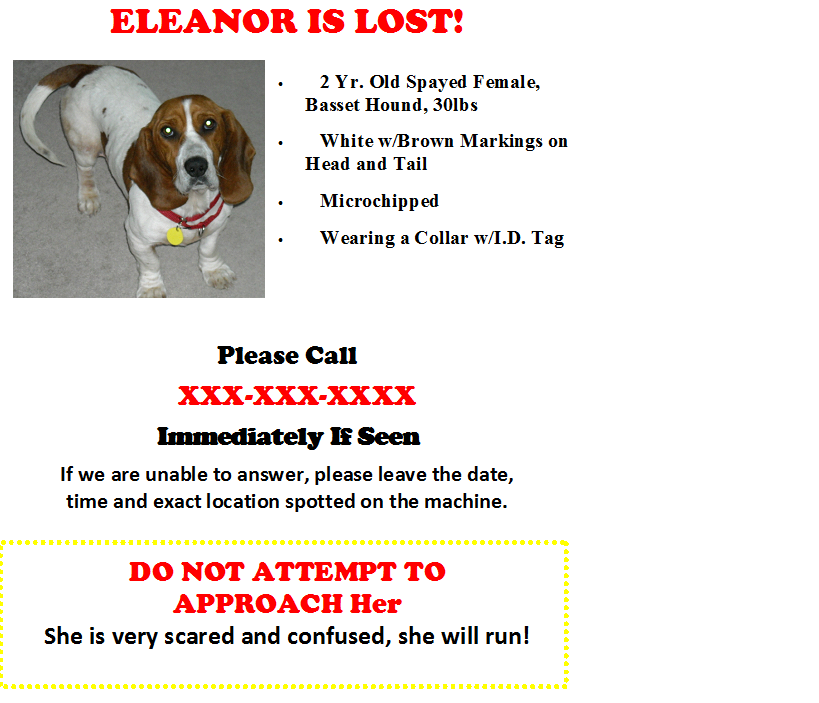
What you should say to your friends and family members is that you’d appreciate them taking some time to put out flyers all over town. Hand each of them a stack of flyers that include a full, current picture of your dog, a description of his or her appearance that highlights any unusual physical or behavioral traits the dog has, and your contact information.

When your friends and family members look at you like you’re crazy, remind them that the most effective way to find a lost dog is by putting up and handing out flyers as soon as possible following an animal’s disappearance. More often than not, a dog is reunited with its family because someone who has reviewed a flyer sees the lost pet, and calls the dog’s distraught owners.

So, if your pet goes missing at some point in the future, gather as many friends and family members as you can, and send each and every one of them out with big stacks of flyers. It is the best way to ensure your lost dog will be returned to your loving arms.