
Payton – Waiting For Rick

Payton1

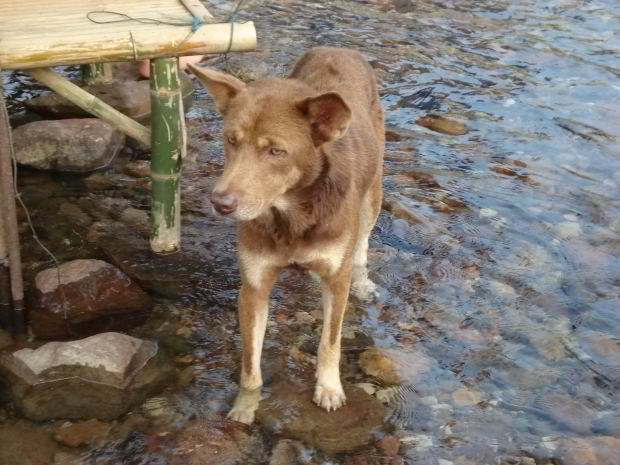
We’d like to share an inspiring story about Payton, German Shepherd-Black Lab mix owned by Rick from Glendale Heights, who went missing recently from a family member’s home in New Lenox.  Payton was supposed to spend a few days with Rick’s cousin, but being the shy boy he is, didn’t even want to get out of the car that morning….until the doors were left open for him…and then he saw his chance to bolt!  Neighbors, Animal Control and the Police Dept. were notified immediately and, though there were a few sightings (so they knew he had stayed in the area)  friends and family driving around all day looking for him just could not find him.  Everyone felt he was looking for Rick, who was out of town!

Flyers were put up all over the next day, and Payton’s info was shared on several sites, including Lost Dogs Illinois.  Upbeat attitudes faltered as there were no sightings this day.  A paid call-search site was contacted and calls went out to surrounding neighbors the next morning.  Rick’s fiancee, Cassandra,  began getting calls of sightings, but whenever she went out,  Payton was nowhere to be seen.

Following guidance from Will County Animal Control, LDI, etc., clothing with Rick’s scent was put out, along with food, and a humane trap.  Cassandra even kept some of Rick’s clothing dangling from her car as she drove around in her search!  Another fruitless day went by…..

On the fourth day of Payton’s disappearance, with Rick back at home,  he, Cassandra, neighbors and friends, (especially Phil and Robin and Laurie from Will Cty AC who spent time on her days off), after passing out more flyers and business cards, searching, and taking more calls of sightings FINALLY saw Payton for themselves as he crossed Rt 80.  Rick screamed for him as Payton re-crossed the busy highway back toward him.  Though they were hopeful, Payton still managed to elude them all.

Animal Control was ready the next day with tranquilizer darts, as Payton was again spotted at the edge of the woods.  Everyone thought this drastic measure would be necessary as Payton, timid by nature, had to be terrified after 5 days out on his own!.  Payton stayed put, as Rick walked toward him.  If he were to come to anyone, it would be to Rick, who had had him for 6 years, since he was a puppy.  Payton turned back toward the woods.   Rick called his name, and Payton turned around and stared at him, as if in a showdown…..at that moment, frozen in time, Rick remembered a tip he had gotten from Lost Dogs Illinois, that advised him to lower himself to the ground.  He laid down flat, always keeping Payton in his line of sight…..and Payton came closer and closer till he jumped on Rick and began licking his face.  The reunion everyone had prayed for was accomplished!  Missing 2/7/13, Home At Last 2/12/13.  Welcome Home, Payton!

By Barb Scalzitti


Lost Dogs Illinois would like to thank Rick and Cassandra for allowing us to share this special story of  Payton’s escape and eventual return with all our fans.  We hope that those of you reading this will use the tips and resources available on our site and through their local ACO’s and communities if the need arises.

Please note:  Chemical capture (commonly called tranquilizer guns) is typically handled by trained animal control officers.  There are serious dangers involved with using this type of capture.  Be sure to ask the officer about these dangers and then carefully weigh the benefits vs. the risks.

Harnessing the Energy – Part 5 (Common Pitfalls)

Lindsay, a shy beagle was successfully captured by the well-coordinated team of volunteers at Midwest BREW.

Lindsay, a shy beagle was successfully captured by the well-coordinated team of volunteers at Midwest BREW.

In this final segment of our series for shelters and rescues, we will focus on some of the common mistakes that can lead to a prolonged search or unfortunately even the death of the missing dog.  Most of these mistakes can be attributed to a lack of leadership or the absence of a strong point person on the case. We covered this in detail in Part 3 of the series. Without strong leadership, the volunteer base will become frustrated and frayed. Some may become disinterested, some may give up, and some may go off on their own, using methods that we would never recommend.  These include:

  • Pitfall #1 – Volunteers physically searching for a dog. Most missing rescue dogs are shy. Foot searches are never recommended unless the dog is a very young puppy (barely walking) or has been severely injured, such as being hit by a car.  In these situations a “grid search” might be warranted. But this must be well-coordinated with a good plan and strong leadership.  Foot searches almost always result in driving the dog further away. He will sense that he is being pursued.  If he keeps getting driven out of the flyering area – there will be a lack of sightings and the volunteers will lose the motivation to flyer larger and larger areas.  You may also drive the dog into hiding, causing a lack of sightings which also causes frustration and makes volunteers lose hope. Worst of all, your volunteers may pressure the dog and cause him to bolt into traffic and be injured or killed.
  • Pitfall #2 – Using a psychic, animal communicator or douser. These are almost always a scam. Or well-meaning people who think they have a  connection with animals but know very little about lost dog behavior. They will appear to be “psychic” but they are usually studying google maps and satellite photos to talk about landmarks, even though they live far away.  Some may do the first reading for free, but then ask for a credit card number for subsequent “readings”.  They advertise on Craigslist and they may contact you offering their services.  The readings will be vague. “I see your dog with an older couple.” “I see your dog in a yellow house.” Getting the word out through the use of flyers and signs brings lost dogs home. Psychics can send you in the wrong direction or worst of all tell you that your dog has “passed”.  Don’t give up unless you find the remains of the missing dog. He is out there somewhere and perseverance, common sense and logic will bring him home.
  • Pitfall #3 – Tracking dogs. There are some legitimate tracking dog services. They are few and far between. Screen them carefully. What is their success rate at tracking a shy lost dog? If their success rate sounds too good to be true, it is. They are a scam.  Remember that good tracking dogs may be able to locate a scent, but lost dogs can move quickly.  There are dozens of “pet detectives” that are currently preying on unsuspecting, distraught lost dog owners. They are using Craigslist and Facebook to advertise for free and will tell you that they can find your dog. Remember, you will still have to flyer, establish a feeding routine and trap the dogs.  Instead, use your rescue’s valuable resources for flyering, signs and advertising.
  • Pitfall #4 – Giving out exact sighting or trap locations – You will need to communicate with your volunteers, preferably through some sort of closed email or Facebook group. But make sure that they understand that what you share is confidential.  You NEVER want to disclose a sighting or trap location publicly – on a Facebook page, in a blog, or to the media. Keep the location confidential because wanna-be heroes, reward seekers, and curious people can derail your plans very fast. Then you will be picking up and starting all over again and you will risk volunteer burnout.
  • Pitfall #5 – Allowing too many volunteers to man a feeding station or trap.  Remember, your lost dog is probably very shy and doesn’t trust many people.  You need him to relax and feel comfortable coming to a feeding station so that you can eventually trap him. If everytime he goes to the location, there are different scents from different people, he may abandon that location completely and move on. Ideally, the person most bonded with the dog should be the one that is refreshing the feeding station and manning the trap. One or two helpers may need to be involved, but a revolving schedule of volunteers is counter-productive.

We hope this series has given you some guidance and ideas if one of your rescue or shelter’s foster or adopted dogs go missing. Searching for a shy lost dog is expensive and time-consuming. Pre-planning, volunteer training and avoiding common pitfalls will save you the time, money and resources that could be better spent on saving more lives.

Previous article – https://www.lostdogsillinois.org/harnessing-the-energy-part-4/

Harnessing the Energy – Part 4

feeding station

Your team of volunteers has worked hard at flyering and posting signs and now you’re getting some sightings! This article will cover what we have found to be the best method for handling these.

The point person should keep a sighting  journal. It is hard to remember all of the details from a phone call. Something that may seem insignificant at first may become very significant as time goes on.  So most importantly, get the name and phone number of the caller, so that you can call back with any extra questions!

Ask the right questions and make detailed notes.

1. Where did you see the dog? Ask them to please be specific. For example: the dog was going north on Ash street toward the Bay City Mall.  On the other side of the street was Walmart.

2. When did you see the dog? What was the weather like? Again, ask for specifics. Example: The dog was seen at 10 a.m. on Monday, August 5th.  It was raining at the time.

3. Can you describe the dog? Was he wearing a collar? What color was the collar? Did he seem okay?

4. What was he doing? Was he trotting, running, darting in and out of traffic, sleeping, playing with other dogs, walking calmly, etc?

5. How was he carrying his body and tail? Was he low to the ground, almost crawling? Was his tail up or down or waggin?

Record all of these details in your journal and then post the sightings to a  map. You can use an old-fashioned paper map or you can use an interactive google or Mapquest map that you can share with your volunteers.   We recommend that you NEVER share this or any sighting information  with the public.

The number one cause of death of lost dogs is that they panic and run into traffic and are killed by a car. When you post sighting locations – you are encouraging reward seekers, wanna be heroes, and overzealous people from rushing to the location and frightening the dog.

Remember, the whole goal now is to let the scared lost dog settle in the area. Then you can implement a plan to catch him (trapping, luring, etc.). But if you are constantly pressuring the dog, he will keep moving, and you will always be behind him. You will have to keep flyering more and more areas and this will be draining on your volunteers. Remember that most of your volunteers have full time jobs, and their own families and dogs to look after. You will need to respect their time and maximize their efforts.

Make sure that your volunteers understand that the goal is to allow the dog to settle in an area. They must change their mindset from “searching” to “luring”.  You wouldn’t try to chase and catch a feral cat. You start feeding a cat in one location and then you trap them. You will use this same approach for a scared, missing dog.

After you get off the phone with the caller, immediately gather the necessary supplies and head to the location. The person most bonded to the dog (if it isn’t you) should also go. But you do not want a large group. You will need:

  • smelly treats (think hotdogs, liverwurst, canned cat food)
  • water and bowls
  • slip lead, regular leash and collar
  • flyers
  • trail camera (or fireplace ashes or cornstarch)

When you arrive at the sighting location:

  • Don’t slam the car door!
  • Stay calm – the dog will feel your nervous energy and may take off again. He could be in hiding watching you.
  • If you see the dog (possible but not probable):
  • The person who is most bonded with the dog should sit or lie down by themselves and scatter tasty treats around themselves and WAIT. It may take minutes or hours for the dog to creep slowly towards them. The dog may circle around and approach from behind. Put your phone on silent and don’t talk on it. Everybody else should leave the area.

If you do not see the dog:

Don’t waste time driving around.

Immediately go door to door and flyer – speaking with everyone. Call in more volunteers to help with this.

If no one is home – leave a flyer that you have handwritten on: SEEN! 4 p.m. May 31 at the edge of your property or corner of this block or across from the Walgreens.  Be specific so the home owner knows to keep a look out. Make sure your flyers clearly state the nobody should call or chase the dog. Just call with sightings.

Before leaving the sighting area:

Leave food and water! Anything except dry kibble (which doesn’t have an odor). Again, think smelly, scrumptious food. If you have a trail camera set it up facing the food so that you can see if the dog is approaching and eating when you aren’t there. . If you don’t have a trail camera, sprinkle fireplace ashes or cornstarch around the bowls so that you can examine the area for tracks when you return.

Remember, when the lost dog’s needs are being met:

He will start to let down his guard.

He will start to trust people and return to a domesticated state of mind.

Your chances of safely capturing him are greatly increased.

Don’t be too quick to dismiss a sighting.  Most sightings are legitimate. People describe dogs differently so don’t dismiss a sighting because the description does not match exactly.  Remember, that the public may not know dog breeds or sizes like you do. They may call an American Eskimo Dog a Samoyed.  Or a shepherd mix a husky. Assume that every sighting is legitimate, unless absolutely proven otherwise,  and mark it on the map. Dogs can travel great distances very fast, especially if they have been pursued. They may be using shortcuts that you aren’t aware of. Don’t assume that a sighting is too far away to be your dog. You will be able to use your map to give you clues to your dog’s paths and patterns.

Next, we will discuss common pitfalls and mistakes that are often made when a rescue is searching for one of their foster or newly adopted dogs. We will try to give you some advice to avoid these pitfalls.

See part 5  https://www.lostdogsillinois.org/harnessing-the-energy-part-5-common-pitfalls/

Previous article https://www.lostdogsillinois.org/harnessing-the-energy-part-3/

Harnessing The Energy – Part 3

Two Illinois based rescues joined together to facilitate Ellie, shy foster dog, return. 30 days later Ellie was trapped.

Effectively coordinating your volunteers in the search for a lost dog is what we call “harnessing the energy”.  When everybody is on the same team and pulling in the same direction, great things can happen.  When the efforts are scattered and fragmented, volunteers will get frustrated and the search can end badly.

This article will focus on the steps to help your rescue or shelter’s volunteers work effectively as a team to generate sightings of the missing dog.

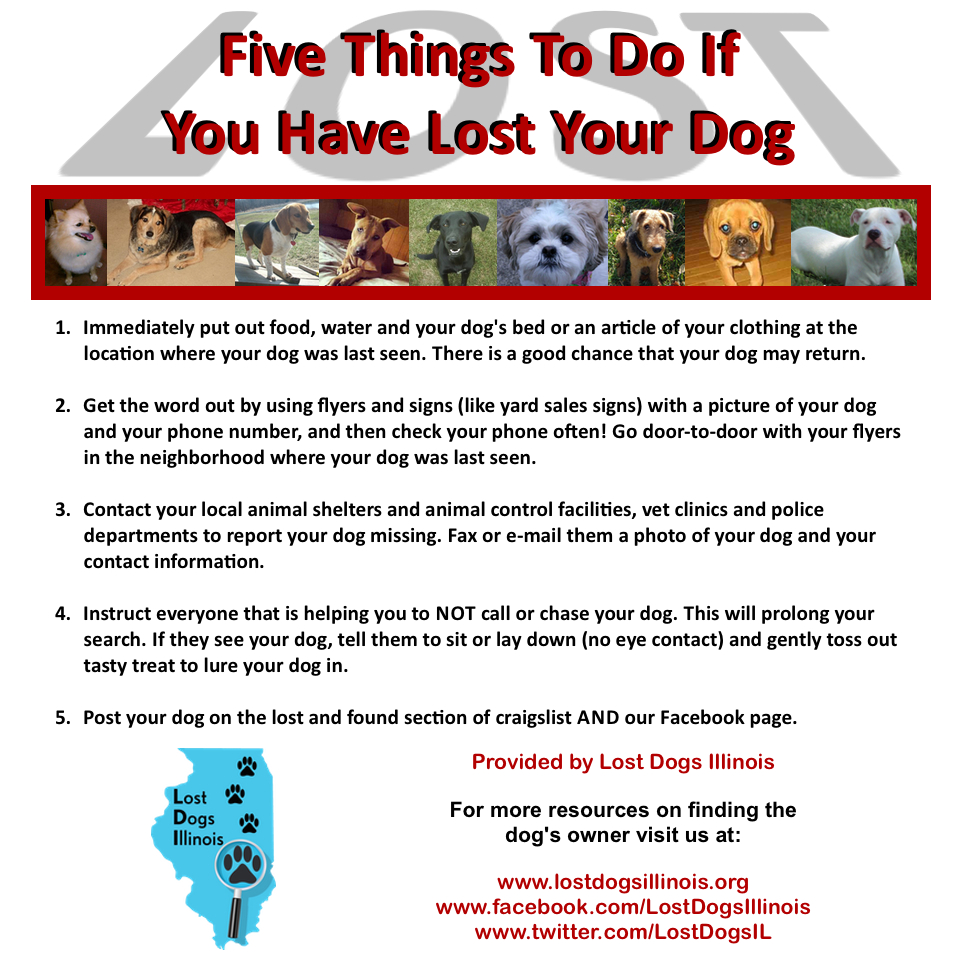
First and foremost – please make sure that you have done the Five Things to Do If You Have Lost Your Dog. Putting scent items and food at the spot where the dog went missing from will help keep him in the area – even if he is unfamiliar with the location.

1. Assign one “point person”.  Preferably this is the person that is most bonded with the lost dog (the owner or foster parent) and with the biggest emotional committment to the process. The point person must be a responsible individual with the time required to be able to answer EVERY phone call and go to every sighting location.  The point person must be dedicated to the process for the days, weeks or months that it might require to successfully catch the dog.

2. Use a phone number on the flyer that will be answered promptly. Do not use a shelter phone number that won’t be answered during closed hours. Do not use an automated voice system or answering service. Many people who see your dog won’t call again. They will try ONCE. If you miss the opportunity to speak with them, you may never get another chance and you might miss valuable information about your dog’s location. Do not rely on texting. Callers need to hear your voice and your emotional commitment to the dog. This will encourage them to keep helping you.

3. Change the message on your phone to include a message about the missing dog. If the caller reaches an ordinary voice message, he may hang up and not try again. The caller must know they’ve reached the correct number to report a sighting.

4. Do NOT offer a reward for the missing dog.  In our experience, this is almost always a bad idea. Rewards encourage people to chase the dog, possibly into oncoming traffic. A dog that is being pursued for a reward will not settle and will become more and more elusive and possibly move out of the area altogether. Then you will have to start all over in a new location.  You want sightings of the dog so that you can implement a plan to catch him safely. Rewards are counterproductive to this effort because you will not be able to pay a reward for each sighting.

5. In the early hours of the dog going missing; rescue volunteers may panic and want to rush to a sighting location to “search”.  This is almost always a bad idea. Their energy should be used for quickly flyering the area – going door to door and trying to speak to as many people as possible and leaving a flyer in their hands.  Searching for a shy lost dog will chase the dog out of the area and possibly into the path of traffic.  Or the dog may go into hiding, reducing sightings and prolonging the search. Your goal is to let the shy lost dog settle, without the pressure of being pursued. You will have a much greater chance of catching him.

6. The point person should be organized and ready to distribute maps and flyers to the volunteers.  Use a Rubbermaid tub in a central location to store flyers, maps and supplies. Then anyone with some time to spare can do some flyering without duplicating efforts.

7.  Don’t congregate noisily in an area to flyer. Don’t slam car doors. The dog may be hidden somewhere nearby watching you. Too much activity may frighten him into leaving the area.  Flyer in groups of two for safety, but be quiet and calm.

8. Pace your volunteers. Make sure they understand that this could take weeks or months. Volunteers will be needed to flyer after every sighting, to make and move signs, to update Craigslist, radio, and  newspaper ads and to keep notifying vet clinics, shelters, etc.

9. Try to keep everyone “in the loop” so they feel useful and engaged. Consider using a closed Facebook group for the volunteers to keep everyone informed. Stay positive. Negativity won’t help and will probably prolong the search. Don’t waste any time in assigning blame for how or why the dog went missing. This does nothing to help find the dog and will decrease the morale of the team.

Next, we’ll focus on the best way to respond when you get your sighting calls.

Part 4  https://www.lostdogsillinois.org/harnessing-the-energy-part-4/

Previous Article https://www.lostdogsillinois.org/harnessing-the-energy-part-2/

Harnessing The Energy – Part 2

How can rescues and shelters prevent  high flight risk dogs from escaping from new adopters, foster homes and even their own facilities? And how can they correctly react when a dog does go missing?

These next few articles will focus on this, starting on how a shelter or rescue can prepare their staff, foster homes, and new adopters for high flight risk dogs.

1. Microchip every dog as soon as it becomes available for adoption, and ENROLL the microchip to the new owner. Some microchip companies do this for free, others have a charge. Offset the cost by adding the enrollment charge (if there is one) into the adoption fee. Simply sending the dog out the door with the paperwork is not enough. Most people have good intentions but may lose the dog before they get the microchip paperwork sent in. They may have just plunked down several hundred dollars for an adoption fee and supplies. The microchip paperwork may get set aside until the next payday and by then it might be too late.

2. Put visible identification on every foster or newly adopted dog before it leaves. ASPCA research shows that 89% of newly adopted pets were still wearing the tags a shelter or rescue put on them six weeks after adoption.

3. Use a martingale collar on every dog (see photo above). These are great for the shy dog that has learned to back out of a standard collar. Also, consider using a sensation harness along with a martingale collar (either by using two leads or clip the lead to both O rings) for those that are extremely high risk.

4. Educate your foster homes and new adopters on the challenges of high flight risk dogs. Put together a packet of information for them to include in their adoption paperwork. Here is a sample from Lost Dogs Illinois that you can use.

Read part 3 https://www.lostdogsillinois.org/harnessing-the-energy-part-3/

Previous article https://www.lostdogsillinois.org/harnessing-the-energy-part-1/


Very Few Dogs are Stolen. But if Yours is, Here are Some Suggestions

KONICA MINOLTA DIGITAL CAMERA

When a dog is missing, the first reaction is often panic. Panic leads to unclear thinking about what really happened. Many people are convinced that their dog has been stolen, before they objectively think through all of the scenarios.

Just last week we had a case where the dog was missing from a fenced yard. The owner assumed their dog was stolen but he had fallen into a window well and was recovered safely. Check everywhere first!

Next we need to clearly define the difference between a dog that is picked up and one that is stolen.  A picked up dog is one that was lost, or perceived to be lost and a Good Samaritan took the dog in,  to keep it out of harm’s way.  Stealing involves a person who commits a crime of intent by illegally entering your house, business, yard or vehicle and taking your dog.  There is a big difference because the motive is different.

If you have reconsidered and realized that your dog was picked up by a Good Samaritan – please read this article instead.

“Stolen” dogs make headlines which makes it appear that it happens more often than it does. But when the dog is recovered, and it wasn’t stolen; the outcome doesn’t get the same media attention. So the public only remembers that the dog was “stolen” when it may have simply been lost or picked up.

The media loves to over sensationalize the story of a stolen dog and pretty soon people’s minds are playing tricks on them – creating all sorts of bizarre scenarios that probably didn’t happen.  At Lost Dogs of Wisconsin/Lost Dogs Illinois we focus on “probability” vs. “possibility”. We never say never, but when we look at the results of our thousands of successful reunions, we see some pretty clear patterns.

In our experience  we have found that very few dogs are actually stolen. And, of those that are stolen, many of those have been taken by somebody that is known to the family.  If you think your dog has been stolen, consider these possible suspects first:

1. A disgruntled spouse, ex-boyfriend or ex-girlfriend, or other family member

2. A disgruntled employee, contractor or anyone you may owe money to

3. An unhappy neighbor who perhaps disagrees with how you care for your dog.

Immediately file a police report. If your dog has been stolen, you need to create a paper trail to help you. You also will need the police department on your side because you will need them to accompany you when you find out where your dog is. You will also want to make sure that the thief is prosecuted.

Regardless of whether you dog is simply lost, has been picked up by a Good Samaritan or has been stolen – the way to recover them is to generate sightings by getting the word out. The following action plan has been written to help you generate sightings if you have concluded that your dog has been stolen in an urban setting.

Action_Plan_for_Stolen_Dog_(3)_(1)

Note:  Any advice or suggestion made by Lost Dogs of Wisconsin/Lost Dogs Illinois is not paid-for professional advice and should be taken at owner’s discretion.

Harnessing the Energy – Part 1

“Finn, a shy lost dog, was successfully captured by a team of volunteers from NBRAN and other concerned area citizens.  This team has now gone on to help capture other lost dogs in the area.”.

There are more lost dogs now than there have ever been.  Pet ownership is up and we, as a nation,  are saving more dogs, with many more people choosing adoption as their option. This is a great thing but it comes with its challenges. For many people, this is their first experience owning a shy, rescued dog. These dogs are often high flight risks and can quickly escape through a door or wiggle out of an ill-fitting collar, harness or slip lead.

Searching for a shy lost dog is expensive and time-consuming. Most shelters and rescues are obliged to help search for a dog that has gone missing from a newly adopted home, a foster home, their transport or their facility. Here is a list of the potential costs associated with a lost dog search:

  • Printing flyers, possibly thousands of them
  • Printing and making intersection signs
  • Newspaper and radio advertising
  • Automated calling services
  • Trap rental or purchase
  • Gasoline
  • Lost wages
  • Shelter/rescue staff and volunteer time that go towards the search instead of their regular duties

When you take all of this into consideration it is very apparent that it is in the best interest of everyone to make sure your team of volunteers knows the most efficient and productive way to conduct a lost dog search.  Your rescue or shelter does have a team, don’t they? A well-trained team that can quickly mobilize when a dog goes missing will save your rescue time, money and possibly the dog’s life.

Since their inception, Lost Dogs Illinois and Lost Dogs of Wisconsin have helped reunited over 60,000 dogs. Most of these were found safely, some ended in heartbreak.   Many of these were from rescues, shelters, transports, or were in foster homes or newly adopted homes. We would like to share with you what we have learned in this next series of articles.

Lindsey, former puppy mill dog, escaped from a fiery crash. Family was injured and from out of town. Midwest BREW’s Find Snoopy team trapped Lindsey.

Part  2- https://www.lostdogsillinois.org/harnessing-the-energy-part-2/

A Picture Is Worth A Thousand Words…….

Earlier this week, a lost dog became stranded on the Kennedy Expressway. NBC News Video  showed concerned citizens and officials trying to capture the dog. It was very heart-wrenching to watch an “owned” female dog that was in pain and scared to death trying to elude her captors, people who took action that was in the dog’s best interest.

Lucky for her, she had a team of guardian angels:

The group of men who captured her on the Expressway.

The director of the American Animal Rescue Society posted the video on the organization’s Facebook page asking for a foster home willing to take care of the dog despite her injury.

Ev, a fan of the American Animal Rescue Society and LDI, posted the video on LDI’s Facebook page asking, “Does this dog look familiar?”

Jackie, a LDI volunteer, jumped into matching mode, found a Craigslist lost dog ad with the dog’s picture and then found the “found” dog listing on Petharbor, the website where Chicago Animal Control posts found dogs.  Jackie was able to determine that all three pictures were very similar so she contacted the owner immediately.

It was like the planets were aligned on that fateful day. Within 24 hours, Lassie was claimed by her owners and was taken to a veterinarian.

So when someone says, “Oh, you should never post a picture of the dog you found,” tell him or her about Lassie because her picture was worth even more than a thousand words…much, much more.

UPDATE:  Dr. Hammer of Norwood Park Animal Hospital is donating his services  for Lassie’s medical needs.


Are There More Lost Dogs Now?

Puppy mill dogs and rescued dogs are often shy, undersocialized and wary of strangers. Photo credit: Frank Schemberger

People are always amazed at how many lost dogs there are posted on our Facebook page. We commonly get the question “Are there more lost dogs now? Why?”

Here is our answer:  YES! There are more lost dogs now. As a nation we are saving more dogs than ever, with many more people choosing adoption as their option. This is a great thing but it comes with it’s challenges. For many people this is their first experience owning a shy, rescued dog. These dogs are often high flight risks and can quickly escape through a door or wiggle out of an ill-fitting collar, harness or slip lead.

These high flight risk,  shy puppy mill and rescued dogs have many vulnerable moments while they are making their way through the re-homing system. Dogs are lost from transports, foster homes and  animal shelters or can be lost from their newly-adoptive homes.

There are also more under-socialized pet store dogs than before. Pet store puppies are often taken from their mothers and litter mates far too early, to make it to the pet store market while they are still irresistibly cute and cuddly. But this deprives the puppies of an important socialization period and can result in a shy, fearful personality.

Shy dogs are also being lost from shelters, vet clinics, groomers, pet sitters and kennels in record numbers. Education is the key! Educating people on how to prevent escapes and how to catch a shy, lost dog (don’t chase or call him) will help more of these dogs get home safely. Thank you for spreading the word and helping us!


Every Door Direct Mail® Can Help Deliver Your Flyers

The number one way that lost dogs are successfully recovered is through the use of flyers and signs that alert the neighborhood and surrounding areas that your dog is missing.

Printing and delivering flyers can be time-consuming and costly. Also, it is illegal for the general public to put flyers into US mailboxes. The USPS has a service to help. How does it work? Use the EDDM® Online Tool to search for neighborhoods you want to reach, and a Postal Service Letter Carrier takes your printed flyers to every home while delivering the day’s mail. Your lost dog flyer gets directly into the hands of the homeowner.  EDDM does not require a postage permit.

Go to USPS EDDM® Online or ask your local postmaster for details.  Some printing requirements apply.

Our tips, ideas and articles are based on information gathered from over thousands of successful lost dog recoveries. Any advice or suggestions made by Lost Dogs of Wisconsin/Lost Dogs Illinois is not paid-for professional advice and should be taken at owner’s discretion.