Lexi’s Story – “Tail” of an ID Tag

10624589_10204650276522569_8427022776615641646_nYesterday my husband and I were driving to Crystal Lake, Illinois for an appointment. On busy Route 14 we saw a black dog eating trash from a McDonald’s bag on the side of the road. A man had gotten out of his car and was walking towards the dog. We pulled off the road to see if we could help. He asked us if this was our dog, but actually we thought it was his dog.

The dog was so intent on eating the contents of the bag that the man was able to hold onto her collar and pick her up. He said he didn’t have time to find her owners so we took her.  Once the dog was in our car, I checked her collar for ID tags. YES! Her name was Lexi and she had an ID tag and a county license tag. I called the number on the ID tag but there was no answer.

My husband informed me we were low on gas and needed to stop to fuel up. At the gas station, I called my friend, Becky, who lives on the same street as Lexi’s family which was on her ID tag. Luckily she was just around the corner doing some shopping so we arranged to meet up and Becky delivered Lexi home.

I got to thinking…. How much would it have cost Lexi’s family to reclaim her from the local animal control if she hadn’t been wearing visible identification?

I pulled up their website:

Redemption Fee: Animals with identification (Id tag, microchips, tattoos), which identifies the owner at their current address  – $45.00

Redemption Fee: Animals without identification or identification which does not identify the owner at their current address – $55.00

Boarding fees – $10.00 daily.

Other county fees are different but the point is the same.

Current ID tags and/or a rabies tag will save an owner time and money.

Does your dog have current identification on his/her collar?  Your dog is depending on you to make sure he or she gets safely home.

Ten Things You Need to Know Before Hiring a Tracking Dog Service

1375911626rvuyxWe often get asked about tracking dog services for missing dogs.  Some of these services are good, some are not so good and some are out and out scams. They will cost many hundreds and possibly thousands of dollars depending on where they are located and the distance they have to travel. Most will also charge an initial phone consultation fee.  Some services will require that you purchase extra products like flyers and signs. Before you hire a tracking dog service to help find your missing dog, please do your homework.  Here are some key points to consider:

  1. Tracking dogs will not capture your dog. They may or may not be able to indicate whether your dog was in an area and the direction of travel. But you will still have to do the work of flyering the areamonitoring sightings,  establishing a feeding routine and trapping your dog.  Tracking dogs are not a magic pill.  If a service guarantees success, they are a scam.
  2. A tracking dog is kept on a long line and can only travel as fast as the handler travels. (consider the fitness level of the human on the other end of the leash). Rough terrain and extreme temperatures will be factors.  Most lost dogs will be able to easily outpace a tracking dog and handler.  Ask the tracking service if you can accompany them on the search with the handler and the dog. Be suspicious if they say no.
  3. Tracking dogs may be a poor choice for scared, lost dogs that are in survival mode. These dogs need to settle into an area and establish a feeding routine.  Tracking dogs may  pressure them out of the area that they may have settled in. You will then have to start all over in a new area with flyering and signs to generate sightings.
  4.  Be very skeptical of services that tell you they will have to keep coming back to “confirm” a scent. Each of these visits may cost you more money and you risk your dog being pressured again out of an area that he may have settled in. You will then have to start over using flyers and signs to generate new sightings.
  5.  There is no accredited school for training scent dogs for finding lost dogs.  Trackers often claim success when it was actually flyers or another method of generating sightings that brought the dog home. Check references and successes thoroughly. Personally check with at least five or six references via telephone. Do not rely on online “reviews”  or recommendations.
  6. Reputable tracking dog services will have a contract for you to review and sign and will take credit cards. Make sure you have a clear idea up front of what the total cost will be.  Never send cash or wire transfer money. 
  7. Tracking dogs have much greater success at finding lost cats (who hide when scared) than lost dogs (who run when being pressured).  Ask the tracking dog service what their success rate is.  If they guarantee they will find your dog, or quote an overly optimistic success rate, they are probably a scam.
  8.  Tracking success depends on many things: the weather, the length of time the dog was in the area, the terrain and environment.  The service should give you an honest assessment of what you are dealing with. The longer your dog has been missing the less likely the tracking dog will be able to pick up a scent
  9. Search and rescue dogs are certified for human recovery only and will not normally be  used for tracking missing pets. If someone tells you they will bring their search and rescue dog to look for your missing dog, be extremely skeptical. Ask to see their training records and their certification.
  10. Some tracking dog services, lost pet services and pet detectives prey on the distraught owner by making unsolicited contact with them from their missing dog flyers.  Be VERY careful. Many of these are scams, or at the very least – very expensive services that do what you can do yourself for a fraction of the cost.

Remember, if it sounds too good to be true, it probably is. Stay calm, do your research and spend your money wisely.   Generating sightings is the key to a successful recovery. Consider how many flyers, signs, newspaper ads or even billboards  could be purchased with the money you would spend on a tracking dog service.  Your lost dog is depending on you to bring him safely home.

Our tips, ideas and articles are based on information gathered from thousands of successful lost dog recoveries. Any advice or suggestions made by Lost Dogs of Wisconsin/Lost Dogs Illinois is not paid-for professional advice and should be taken at owner’s discretion.

A Volunteer Chain Reaction; Jaxx’s Journey Home

FotoFlexer_Photo

On July 4th, 2014 a Chicago family’s dog, Jaxx, went missing from his yard. His family really missed him and wanted him home. Trying to think of ways to help find him, the family finally posted a picture of Jaxx on the Lost Dogs Illinois Facebook page asking if anyone had seen him.

Irene, one of the Lost Dogs Illinois volunteers, saw the family’s plea for help and remembered seeing a listing for a dog that resembled, Jaxx, on the Petharbor website. The listing she remembered on Petharbor was for a dog being held at Chicago Animal Care & Control and had been brought in the same day Jaxx, went missing. Irene checked back on the website, but the dog she remembered was no longer listed. Hoping it wasn’t too late to find the dog and confirm him to be Jaxx, she quickly opened the CACC Transfer Team Facebook page. Thankfully, CACC has a special group of volunteers that work with the dogs that are brought in. They allow them to run a Facebook page representing the dogs at CACC. They use social media as a tool to network the dogs to help find rescues groups, potential foster homes, potential adopters and another avenue that could allow a family to find their missing pet.

As luck would have it, the LDI volunteer did find a video of the dog she saw on Petharbor on the Transfer Teams’ page. Irene contacted her fellow LDI volunteers with a link to the video for a second opinion to see if they also thought the dog was a match for Jaxx.   The consensus was an overwhelming, “Yes!”.  Irene then was able to send the video to Jaxx’s family and they agreed that, indeed, that was their boy! Obviously, they wanted to know where they could come get him. The problem now was, it seemed that Jaxx was no longer listed on Petharbor because he had already been pulled by a rescue group and was no longer at CACC.

The volunteer chain reaction was already well underway. Through the work that LDI does, some of the volunteers have become friends with some of the CACC volunteers. LDI volunteer, Irene, asked another LDI volunteer, Jackie, if she could help locate Jaxx through her connections with the CACC volunteers.   Quickly, Angie, from the Transfer Team page was contacted. Immediately, the CACC volunteer jumped into action to try and find out where and to what rescue group pulled Jaxx. Lo and behold, Jaxx, was now with  Retrieve A Golden of Minnesota.   Yes, you read that right, Minnesota. Now what? The CACC volunteer asked if more pictures showing different views of Jaxx could be forwarded to her from the family while she gathered the contact information for the rescue. Angie was able to forward those pictures to the rescue and to Jaxx’s foster family. All parties agreed it was a match. Jaxx was now part of Retrieve a Golden and could be adopted out, but the rescue knew that getting Jaxx back to his original family was in his best interest. Now, how to go about doing that is something else that needed to be figured out.

To add another layer to this story was the fact that Jaxx’s foster family was not in Minnesota, they were in Iowa. Yep, Iowa! After dozens of emails, many texts and several phone calls, arrangements were made to meet Jaxx’s family at the Iowa border the following Saturday. The rescue also has volunteers that help drive different transportation legs when they need dogs transported for their rescue. One of those volunteers offered to pick up and drive Jaxx to the Iowa border for the impending reunion.

Jaxx’s family and all of the volunteers involved waited on pins and needles for the day Jaxx would finally be home sweet home. Finally, on the afternoon of July 26th, it happened. It was obvious that, Jaxx, had been well cared for while on his little adventure.   One final volunteer chain reaction happened while they passed around a picture of Jaxx riding happily home in his family’s car, smiling from ear to ear, looking fluffier than ever.

We, at LDI, would like to thank everyone involved in this volunteer chain reaction to get Jaxx back to his rightful family. Remember Jaxx didn’t need a new home; he needed to go home!

Lost Dogs of America Announces the First Annual National Lost Dog Awareness Day

get-attachment.aspxOn April 23, the U.S. will celebrate its first annual National Lost Dog Awareness Day (NLDAD)! Created by Susan Taney and Kathy Pobloskie – directors of Lost Dogs Illinois and Lost Dogs of Wisconsin, respectively – the canine-centric holiday aims to bring attention to all dogs that are lost each year. On a happier note, NLDAD also celebrates the thousands of lost dogs successfully reunited with their families.

Lost Dogs Illinois (LDI) is an all-volunteer organization created for the exclusive purpose of providing a free service to help reunite families with their lost dogs. With the help of popular social media platforms, Facebook and Twitter, and their extensive connections throughout Illinois, LDI is able to facilitate a statewide alert as soon as a lost dog posting is released. By working to recover lost dogs, this 501 (c) 3 non-profit helps to decrease the number of homeless animals brought into shelters and animal control facilities, thereby preventing unnecessary euthanasia. Lost Dogs Illinois offers an invaluable service when many feel helpless otherwise. The Lost Dogs mission has been
so successful that the concept has been accepted and put into practice in Wisconsin, Arizona, Minnesota, Texas, Florida, Colorado, New Jersey and Iowa under the umbrella organization Lost Dogs of America.

The tenacious efforts of these combined states’ volunteers along with over 150,000 fans have helped reunite over 21,000 dogs with their families since 2010. Getting lost dogs back home reduces stress on owners’, staff at shelters/animal control facilities, other dogs in the facilities, and ultimately saves taxpayers’ money. It also opens up cage and kennel space for truly homeless dogs.

“When a dog goes missing, many families give up looking for their lost pet. National Lost Dog Awareness Day was created to give hope to the families still looking for their dogs and remind the public that not all stray dogs are homeless” explains Taney. “One of our most recent success stories was finding a beagle named Charlie. He was missing for almost two months in the most brutal winter ever. We never gave up, and neither did Charlie’s foster family. Together, and with the help of our social media following, Charlie was trapped and he was successfully reunited with his foster family. Never doubt a dog’s ability to survive.”


Tips to Keep Your Dog Securely in Your Yard

1004968_723077971056885_1883505027_a
The neighbor’s husky pup can’t get past the buried landscape timber. An hour later he made his way into my yard. He found a spot where there was no barrier. 

by Barb McDonald, LDOW Volunteer and Founder of the Lost/found Husky Dogs Facebook page

Here are some ways, many cheap and still very effective ways to keep your dog from getting through the fence and getting lost. Dogs that jump over, climb over, dig under, squeeze through gaps, etc. Some ways can also help keep coyotes and other animals out of the fence as well. Most of these will work for almost any type of fence

DOGS THAT CLIMB THE FENCE– Use Coyote Rollers or Lean Ins. Coyote rollers are mounted at the top along the entire fence and they literally roll so it’s impossible for your dog to get a grip on it to get over the fence. If you’re a handy man you can make these out of PVC pipe for cheaper. Just make sure they ROLL and that you place them high enough to keep your dogs paw from getting stuck but low enough to keep your dogs head/body from getting stuck. These can be installed on pretty much any type of fence and also work great for keeping coyotes and other animals out of your fence and keeping your animals safe.Lean ins are simple and cheap. You can use welded/chicken wire for these. It’s just angled fencing attached to the top. This makes it impossible for a climbing dog to keep a grip to get over the fence. Both of these methods are used at wolf hybrid rescues to keep them from escaping. Both can also be taken down and moved if you ever move to a new place.

DOGS THAT DIG UNDER THE FENCE– Use a “no dig” fencing/L-footer system. For no digging wire/fence you can use welded wire literally dug into the ground and buried at a slant but enough left out to connect it to the fence. If you have to cut the wire for any reason be sure to keep the sharp edges facing where the dog won’t come in contact with them or you can dull the ends of them. You can also use welded wire and lay it directly on the ground along the fencing still connecting it to your fence though like an “L.” To secure it to the ground use lawn staples. You can always use concrete to make a no dig “fence” or footer too. Same concept but with concrete.

DOGS THAT SQUEEZE THROUGH SMALL SPACES– If your dog is squeezing through small spaces such as the spaces in a picket fence you can do a couple things. You can buy a puppy bumper. They connect to the collar so as long as the collar fits correctly the bumper won’t fall off. Do not make your dog wear these 24/7 & make sure there is nothing around your dog can get caught on. Use them when letting the dog out to potty or just to run around and play for bit. They are light weight but your dog may need time to get used to it because it may be a little “uncomfortable” at first but it’s better than having a lost dog. Besides a puppy bumper you can use a Bar Harness, these are just a few dollars more but will work better with wider gaps and probably more comfortable. They make these for large dogs as well.If you don’t want to use a puppy bumper/bar harness you can always line the fence with a mesh wire, they do sell some mesh wire that is hardly even noticeable. If you don’t like the look of wire you can use bamboo rolls to line the fence with.

DOGS THAT DASH THROUGH THE FENCE DOOR WHEN OPENING IT– Simple and quick fix. Make an Airlock Fence Entrance. This is just a small extra fenced area/barrier attached to your fence entrance (inside the fence or outside the fence) so if your dog dashes out it prevents him from running off by keeping him inside the entrance. Making it easier on you to keep your dog in the yard. Also great for people that have kids that don’t always pay attention when opening the gate and causing the dog to get loose. If your fence doesn’t stay latched, buy new latches and/or locks. If you’re worried about your dog dashing through the front door and it’s a small dog a wrap around baby gate as an “airlock entrance” may do the trick for inside the home.

FENCE JUMPERS– Remove anything the dog can use to help them jump over the fence… tables, dog house, etc. Install an extension either to make the fence taller by using welded wire or to put a flat barrier to block them from getting past where they jump.

*If your dog is just squeezing under a chain link fence that has gaps under it or just isn’t secured to the ground… you can buy some lawn anchor/staples for $15-$25 and secure the bottom of the fence to the ground.

*If your fence has a hole patch it up or if it’s possible remove that section of the fence and replace it with a new section.

OTHER TOOLS: 

COYOTE ROLLERS- http://www.coyoteroller.com/

LEAN IN’S- http://www.inetdesign.com/wolfdunn/containment/barbarms.html

NO DIG FENCING/L-FOOTER-http://www.humanesociety.org/animals/resources/tips/digging_animals_fence.html

PUPPY BUMPER- http://puppybumpers.net/shop.htm (might be cheaper on Amazon)

BAR HARNESS- http://www.dog-gamutt.com/store/

AIRLOCK- (Can’t seem to find anything online explaining how to make one of these for a fence. If you look at the picture I’m sure you’ll be able to make it just fine.)

LAWN STAPLES- http://www.radiofence.com/pet-fence-staples/?zmam=59663114&zmas=1&zmac=4&zmap=SS-100&gclid=CNHNmLPg4LwCFa9FMgodlyAAJg

http://www.amazon.com/A-M-Leonard-Anchor-staples-Pack/dp/B001FA9SBG

HEIGHT EXTENSION FOR FENCE JUMPERS- http://www.youtube.com/watch?v=sYcqVBA0WKA

Place an Ad in Your Local Newspaper When Your Dog is Missing

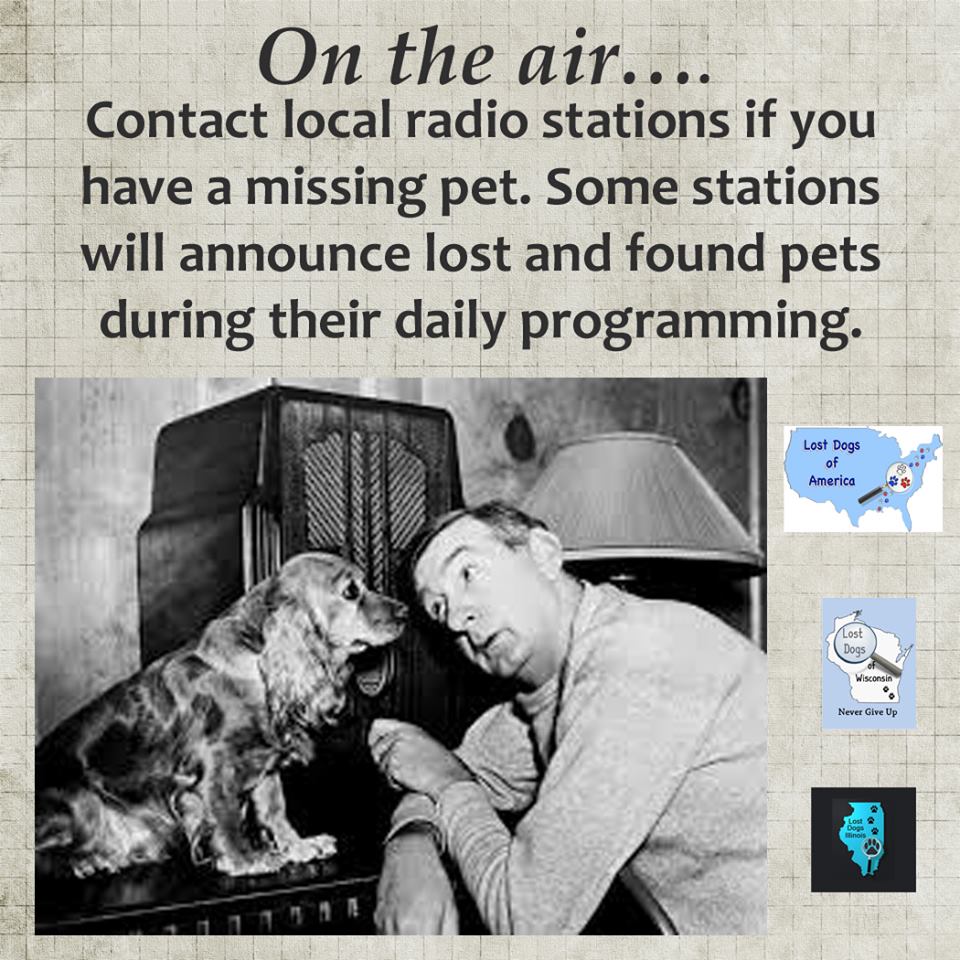
OLYMPUS DIGITAL CAMERAOne of the most overlooked ways to get the word out about your missing dog is placing an ad in your local newspaper or shopper. Social media has taken the world by storm, providing a cheap, easy way to spread the word; but you must always remember that there are still many people that don’t use computers or social media. It doesn’t do any good to have your dog posted only on Facebook if the person that has found your dog isn’t a Facebook user.  So it is really important to use as many different communication methods as possible including flyers, signs, social media, Craigslist, newspaper and radio ads.

The following is a list of Illinois newspapers per township.  Remember that lost dogs can travel far and wide. Don’t limit yourself to just one area. Cover surrounding counties as well.  Your dog is depending on you to bring him safely home.

Click here for a list of Illinois newspapers:

http://www.usnpl.com/ilnews.php

For the Love of Abby

For the Love of Abby

On December 27, 2013 our beloved Toy Fox Terrier, Abby ran away from our in home pet sitter while we were on vacation in Florida.  Despite the best efforts of friends and notifications to Animal Control, Lost Dogs Illinois and local veterinarians, our baby was found deceased.  The whole episode has been so heart breaking, that I hope no one ever has to go through what we did.  Below are some tips for keeping your dog from becoming one of the lost.

  • Micro-chip your pet.  It is very easy and cost effective to do.
  • Tag your pet.  In some towns, this is required by law along with a rabies tag.
  • If someone other than you or any of the family members that the pet lives with are taking your dog out for any reason, have them take the pet out on a leash no matter what!  Your friends would feel awful if your pet escaped on their watch.
  • Periodically check the fenced yard your pet uses.  Check for broken pieces on wood fences and bent areas on chain link fences.  Make sure lawn clippings piles and wood piles are not too close to a fence line giving your pet an easy stairway over a fence.
  • Interview all pet care givers that interact with your pet and in some cases your home.  Have a meet and greet with the caregiver and the pet.  Are they insured? Bonded? Licensed if your jurisdiction requires?  Do they have references?  Any internet reviews?  DO THEY HAVE A LOST PET PLAN??
  • Always require that all caregivers have a leash on your pet when out of doors.
  • Have pictures of your pet on your phone or in your computer archives.  Especially useful, are pictures of your pet next to an object (like a footstool) to give a sense of the pet’s size.  Have a picture that shows and unusual markings or features like two different colored eyes or odd shaped spots, etc.  If a lost flyer needs to be made, it can be done in a hurry.


Despite all of your best laid efforts, some dogs can still escape and become lost.  Now what?

  • Let neighbors know that pet is missing.
  • Contact town police and Animal Control.
  • Post listing on Lost Dogs Illinois
  • Have family and friends search with flyers in hand or at the very least a picture on their phone.
  • Have someone contact any vets or shelters in your area by phone.
  • Drop off or email a “Missing” flyer to all area vets, shelters & rescues.
  • Use social media and other internet portals but do not offer a reward as this can attract scammers. Have your Facebook/ Twitter friends in the local area spread the word.
  • Put flyers in the windows of local stores, especially gas stations.
  • Think outside the box:  put up stake signs (yard sale signs) with your flyer on it at local intersections.  Live near a sports field?  Hand out flyers there.  Live near a commuter train station?  Put up flyers there.  Live near a school? Leave flyers at the main desk to be given to the PE and maintenance staff.  Live near farmland?  Ask the owner if you can check the outbuildings.
  • If your pet is still missing after several days, re-group and touch base with all contacts.
  • Continue developing new contacts to send information to and try to stay motivated during your search.


Developing a missing pet plan now may help you identify and address safety issues preventing a lost pet.  While we will never ever forget what happened to our darling girl, we found we so loved having a dog in our lives that we have adopted a rescue dog.


For the Love of Bean

                                                        
Thank you Janice D.