Google Maps – A Useful Tool for an Elusive Dog

You’ve lost your shy dog and you’ve done a good job delivering flyers and posting intersection signs. Now your sightings are coming in but you’re having a hard time keeping track. The sightings seem to be all over the place. It couldn’t possibly be your dog, in so many places, in such a short amount of time. Or could it?

Lost dogs in survival mode require three things. They require food and water, hiding places, and avoidance of predators (people).  If you use maps and satellite photos to assess food sources, hiding places and safe, secluded routes of travel; you may start to see a pattern emerge. Using an online mapping service is an invaluable tool to help you record and evaluate your sightings.

Google Maps is a free web mapping service that can help you plot your sightings and give you  clues to your dog’s whereabouts. Be aware though, that Google maps and satellite images are not updated in real time, they could be several months or years old. New construction may not appear on the maps and photos. Buildings and landscapes change and you will have to take that into consideration. Photos are taken during different seasons. Summer photos will appear very different from photos taken in the same area in the autumn after the leaves have fallen.

Different areas of the country have satellite photos taken at different resolutions. Generally, the more populated the area – the better the photo, and the closer that you will be able to zoom in and see detail. Many urban and suburban areas also now have Street View – a setting that lets you see buildings and landmark features as if you were standing on the ground in front of them.

This blog isn’t a tutorial on how to use Google maps. There is plenty of information on-line. Instead, we want to give you some specific tips on how to determine where your dog may be. The best way to learn how to use Google Maps is to dive in and try it. Enter the address where your dog went missing from. Practice changing from map to satellite (aerial photo) view, and zooming in and out.

Practice adding place markers for the following. Use different colors and symbols for:

  • Locations where your dog went missing from
  • Every sighting with a time and date
  • Areas flyered
  • Sign locations
  • Potential food sources
  • Potential hiding places
  • Potential routes that your dog is traveling

Switch to satellite view. Objects viewed from the air appear different from the ground.  Practice somewhere  you are familiar with. What do these things look like from the air?

Common landmarks:

A golf course:

A cemetery:


A shopping mall:


A mobile home park:


Vertical  landmarks from the ground may not be easily apparent on a satellite photo.  Watch for the shadows made by the objects. Vertical landmarks include:

  • Water towers
  • Power lines
  • Church steeples
  • Cell phone towers
  • Tall buildings
  • Doppler radar sites


A water tower in satellite imagery. It looks like a golf ball, but notice the shadow that it casts

Look for possible hiding places that lost dogs commonly use:

  • abandoned farms and homes
  • cemeteries
  • golf courses
  • parks near populated areas
  • industrial areas
  • run down neighborhoods
  • quiet suburban neighborhoods especially if they adjoin parks and trails

Look for possible routes of travel that lost dogs commonly use:

  • bike and hiking trails
  • fence lines and the edge of fields
  • logging roads
  • power lines
  • pipelines and cut lines
  • railroad tracks

Be aware that narrow roads, trails,  and power lines may “disappear” in summer photos because of tree foliage. Railroad tracks are usually very apparent in photos because of the width of clearing around the track bed. Trees do not usually overhang train tracks.

Look for possiblefood sources:

  • restaurants and hotels
  • farms (cat food, corn and spilled grain)
  • convenience stores and grocery stores
  • campgrounds, picnic grounds, rest stops and parks
  • golf courses with food services
  • food processing plants
  • feed mills

Keep your Google map updated and share it via email link with the friends, family and volunteers that are helping you. Lost dogs will often fall into an habitual pattern, visiting the same food sources and using the same hiding places and routes of travel. Flyer these areas heavily to get more sightings. Place intersection signs strategically so that passersby will also be on the lookout for your dog.

You may realize that sightings that seemed impossible at first, really are possible when you view them from the air. Driving routes are often much longer than the routes that lost dogs will take. Using shortcuts, they can travel what appears to be a long distance in a short amount of time.

Advances in technology are giving us more and more tools in the toolbox of lost dog recovery. Using Google Maps can save you valuable time when recovering your lost dog.

A tutorial showing how to create a Google map and drop markers to help you organize an effective search for a dog created by Retrievers Volunteer Lost Dog Team: https://www.youtube.com/watch?v=tQRfKf2gb4k


-Good Ol’ Mugsy

-From the day he was born, Mugsy, a Golden Retriever mix, was a special dog. Nine years ago Elizabeth and Kevin Gerrard adopted his mom only to find out the next day that she was pregnant. Several weeks later Sandy gave birth to seven puppies and all but one were given to good homes. Little Mugsy suffered grand mal seizures and required special care, so Elizabeth and Kevin kept him. Now that Mugsy is a senior, he is taking medications for epilepsy and hypothyroidism and requires frequent visits to his vet.

Mugsy, taking it easy

This is one of the reasons that the Gerrards were so scared when, in April, Mugsy escaped through their storm door. Besides being on medications, they live in an area of  Bloomington, IL near several busy roads and his inability to move quickly would put him in added danger. They immediately searched their neighborhood’s streets and alleys on foot and by car. To their surprise, they realized he must have gotten further than they thought possible. There’s a chance he was hiding really well, as dogs who are frightened often do.

Next, they called Animal Control to give a description of Mugsy; should anyone have found him and turned him in, they would have the Gerrard’s phone number.  They listed his photo and information online, using sites like Craigslist, WJBC’s Pet Hotline , neighborhood association Facebook pages and Lost Dogs Illinois. On our site, they found our Lost Dog Search Action Plan and found the fan interaction very helpful. Our fans are so supportive!

Per a thorough search plan, the Gerrards contacted the Humane Society of Central Illinois as well as all of the vets and animal hospitals in their area. They made posters and hung them everywhere they could think of: stores, gas stations, golf clubhouses, restaurants, apartment complexes, and office buildings. Elizabeth and Kevin drove around for five-to-seven hours every single day searching for their beloved Mugsy.

It wasn’t until a very long 22 days later that they received the call they’d been waiting for. It could have been very good or very bad news. (Sometimes senior dogs and those with health problems can’t make it on the streets for such a long period. Finding food is difficult, being off of medications is dangerous, and a lack of agility navigating busy intersections and highways can unfortunately be fatal.) The caller was an animal control officer who told them he received a report of a dog wandering around near Laesch Dairy, located in a rural area about 20 miles from their home. The officer drove to pick up the dog and  he matched Mugsy’s description!

When Elizabeth picked Mugsy up from the animal control facility, they say he was “very happy to see her,” but, he didn’t look very good; it was clear he’d had a rough time in the wild. He had burrs in his hair, one of his eyes was red and swollen, and he was visibly skinnier. Elizabeth immediately took Mugsy to the vet- which they say he didn’t mind at all as he was accustomed to going there- where they removed his burrs, gave him prescription eye drops, and weighed him. He lost 10 pounds total, which wasn’t actually the worst thing in the world; he had been slightly overweight.

Once home, the Gerrards describe his behavior as “very clingy.” He obviously missed his family while gone and was afraid to leave their side.  He couldn’t seem to get enough water, but they kept him on his medication regimen and they say he’s “starting to be his old self again.” Now Mugsy is well on his way to rehabilitation and the Gerrards have put safeguards in place such as installing a gate at the end of their front porch as an extra layer of security in case he makes his way out again. Also, they’ve ordered a GPS device which will allow the couple to track him on their computer and phone if he somehow gets lost again. It seems the Gerrards are doing everything in their power to ensure Mugsy spends the rest of his years by their side, right where he belongs.

Change Your Voicemail When Your Dog is Lost

We thought we’d take a moment to tell you how important it is to change your welcome messages on your voicemail and answering machines if your pet goes missing. Even though this is a task that many owners of lost dogs overlook, the importance of changing your messages to reflect your dog’s status as “missing” cannot be overstated.Voicemail

Because most people cannot always answer their phone, it is important for you to realize that your recorded greeting is what will make a first impression on someone who is trying to share information about your lost pet when you are not available to take a call. If your message does not indicate that your dog is lost and you are trying to recover your pet, but are simply unable to answer the phone at that exact moment, the caller may decide you don’t really want your dog back. Or the person may think you don’t deserve to get your dog back since you didn’t have a moment to pick up the phone.

Right or wrong, people can be justifiably or unduly judgmental. So it’s vital that your message communicate that your dog is currently missing, you are eager to have your pet returned to you because you love and care for him or her, and that you will respond to any caller who leaves a message for you as quickly as possible, as the following exemplary message does:

“Wait! Please don’t hang up! I have a lost dog. If you are calling because you think you saw my dog, please leave a message. I’ll return your call as soon as I possibly can. Thank you for your help!”

Look at it this way. If one of your family members was missing, any caller could be trying to contact you to share information necessary for your loved one to make it back home. And since many of us view our pets as children, the circumstances are very similar, meaning every caller could provide information that helps you get your dog back.

So it is imperative that you change your voicemail and answering machine greetings to messages that will encourage, not dissuade people to leave messages for you. Simply changing your messages can be the difference between someone choosing to leave a helpful message for you or not. It could mean the difference between your dog being returned to you or not, in other words.

To create your free flyer and social media links to help you generate sightings of your missing dog please file a report with our partner, Pet FBI at www.petfbi.org.  One of our volunteers will post your dog’s listing to the appropriate state or provincial page.

1/12/2021

-Please Read Our Open Letter


–We would encourage you to email, mail, or drop off a copy at your local animal control/stray holding facility or shelter. Thank you so much for your help! You, our fans, are the ones who help us to make small changes that benefit the animals. Don’t ever underestimate the power of one!

Dear Animal Care Colleague,

Thank you for all you are doing to help the animals in your care.  We appreciate the effort you put forth on a daily basis to help return lost pets to their owners and to adopt others into new families.

At Lost Dogs Illinois our mission is to reunite lost dogs with their owners.  We’d like to share some suggestions to help lost pets make it back home and hope by doing so the following practices will become standard in every animal care facility.  We feel we can all then work together even more effectively resulting in an increased likelihood that lost pets will ultimately be reunited with his or her family!

  1. Scan every animal that is brought to your shelter for a microchip using “Best Microchip Procedures.”
  2. Keep detailed records about where and when an animal was picked up and make this information available to the public.
  3. Keep detailed records of calls your facility receives from people who have lost a pet.  Request that they send in pictures of their lost pets and show the photos to your staff members and volunteers immediately after you receive them.
  4. Use an easily-accessed bulletin board where owners of lost pets are welcome to post their “lost pet” flyers.  Use a volunteer to maintain the board and have the volunteer call the owner identified on each flyer every week to see if the individual has found his or her pet.
  5. Add links to your shelter’s website to reference articles and other sites that provide owners with reliable advice about how they can find their lost pets.
  6. Post pictures of lost pets brought to your facility on your organization’s Facebook page and/or website.
  7. Mention whether a dog that is adoptable or impounded was brought to your shelter as a surrender or a stray. Use Helping Lost Pets website, a national database of lost and found animals.
  8. Have volunteers or staff members compare lost pet reports with the animals your facility is holding as strays to see if any match.
  9. Scan every animal in your shelter one last time before allowing him or her to be adopted or euthanized.

Thank you for taking the time to review the above list.  And, again, thank you for your commitment to the animals in your shelter.  We know that without your efforts, very few lost pets would ever make it back to their respective homes or get a second chance with a loving family.  We are truly grateful for everything you do.  And we look forward to working with you and your facility for years to come.

Sincerely,

Lost Dogs Illinois

Lost AND found: Microchips

–One of the best stories I was witness to was because of a mircochip.  When I was working at my county animal control – a stray Golden Retriever came in.  We scanned the dog, as was protocol, and found that his information led us to a woman in Florida – I live in IL.

We called the woman and she began sobbing uncontrollably.  When she finally composed herself – we found out that she had lost her dog two years ago during a hurricane.  Within 24 hours she was on a plane and meeting one of our officers at Ohare International Airport – taking her dog home for the first time in 2 years.

How the dog ever got to IL we may never know – but it is likely that he was rescued at the time of the hurricane and, perhaps, lost in the shuffle of confusion and never scanned or the scanner that the rescue used did not pick up his particular microchip.

Here are some facts about microchips: there are multiple manufacturers of them and the chips are not all set to the same frequency.  There are 3 possible frequencies: 134.2 kHz, 125 kHz and 128 kHz.  There are also two types of scanners: forward scanners which only detect 134.2 kHz and Universal (forward-backward) scanners which will detect all frequencies.  Unfortunately, there is no regulation on what types of chips are used or what scanners are in operation so any scenario is possible.

The best thing to do is to get your pet an ISO standard chip, which is the 134.2 kHz, because that is readable by any of the scanners.  If your pet is already chipped with one of the other types of chips – you can have them re-chipped: the two chips will not interfere with one another and you have twice the protection that your pet’s chip will be detected.

Statistics which demonstrate the effectiveness of chipping: Out of 7700 strays 21.9% of unchipped dogs were returned to their owners while 52.2% of chipped dogs were returned.  Nearly double the percentages.  For cats, the numbers are astonishing!  1.8% of non-chipped cats were returned and 38.5% of the chipped cats were returned.

I assume that the cats’ number is influenced by how few probably had ID tags/collars but still the numbers only reinforce the importance of microchipping.  It truly can make the difference between getting your pet back or losing them forever.

In the study there were animals who were chipped but not returned to their owners and this was primarily because the information held by the chip company was inaccurate.  Meaning that either the animal was registered to the wrong person or facility or the information on file was no longer accurate for the current owner, ie: wrong phone number.

It is important to understand how chipping works… If you get your dog from a shelter, rescue or breeder – it is likely that they will be chipped.  However it is also likely that the information registered will be that of the rescue, shelter or breeder and not your own.  Often you will be given a new registration form or phone number to contact and change the information to your contact info but many people do not follow through on this step.

If you are like me – you might not even recall if you followed through or if all of your pets are microchipped so what can we do?

1)    Call and ask your vet or local shelter if they have a Universal scanner and then take your pet there to be scanned

2)    Once they scan your pet, they can tell you what company your pet’s chip is from and you can find out the frequency

3)    The ID number from the chip will allow you to check the accuracy of the information on file and if necessary you can make any changes

4)    If you find your pet is not chipped, you should request that your pet be chipped with the ISO standard chip with a frequency of 134.2 kHz to ensure that any scanner will be able to identify it.  You might have to shop around for this because vets, shelters and rescues all use different types of chips.

And while chipping is certainly a major factor in having your pet return home – the number one factor is having a collar with proper ID tags including your CURRENT contact information.  A cell phone number is far better than a home number for a few reasons: if you are traveling with your pet when they become lost – you can be reached and if you are out looking for your dog that means you are not sitting by the home phone.  It is also a good idea to have your pet’s CURRENT rabies tags on their collar.  This puts people at ease that your pet is up to date with vaccines and there is a number on the rabies tag that also identifies them with the local animal control.

If only our pets could talk – none of this would matter.  But, they can’t so it is our job to make sure people know who they are and where they live.  If only we could stop them from chasing squirrels or cars or wandering off – but their curiosity and unbridled passion for life is why we loved them in the first place.

For more information on the study and other FAQ’s:

http://www.avma.org/issues/microchipping/microchipping_faq.asp

By Becky Monroe – Guest Blogger for Lost Dogs Illinois

Check out Becky’s blog:  http://www.tailsandtruths.blogspot.com/


Brinkles, and the Power of Facebook Fans

Stephanie was at work when her husband called. “I lost our daughter,” he said in a panic. Mark was referring to their lab mix, Brinkles, who’d been in their family seven years- since she was a puppy. “I had to calm him down and reassure him that Brinkles was okay and that we would find her,” said Stephanie.

The beautiful Brinkles

Mark was calling from Montrose Dog Beach on Chicago’s North Side. Brinkles and their other dog, Charlie loved playing at the beach. Chicago Park District’s first legal off-leash beach, it is very popular and quite busy- especially in the mornings. Stephanie and Mark took them there weekly in the summer and at least monthly in the colder months.

That particular day, Charlie had escaped to the neighboring beach, restricted to people only (The dog beach is gated and fenced on two sides- the lake being the third. But there are ways for sneaky dogs to get out.) Mark chased after Charlie, assuming Brinkles was at his side.

Meanwhile, a woman named Eileen saw Brinkles hanging out near the gate, looking for a way out. She asked around to see if she belonged to anybody. The dog beach has a rule about dog owners remaining with and watching their dogs at all times, so she thought Brinkles may have been abandoned. Out of concern for her well-being, Eileen took her home to keep safe while she made efforts online to find an owner.

After wrangling Charlie, Mark came back to the beach area, getting ready to take the dogs home, when he noticed Brinkles was missing. He too talked to people nearby and they told him about a woman who left with the dog but they didn’t know her name or how to reach her. That’s when Mark called Stephanie and set a plan in motion to get her back as quickly as possible.

Mark raced to Stephanie’s work and they immediately went to the city pound- Chicago Animal Care and Control. On the way there, Stephanie used her phone to post an ad on Craigslist– a common place for lost and found dog ads. When they had no luck at the pound, they turned back home to brainstorm more methods of finding Brinkles. Stephanie got on the computer and had a message waiting from someone who saw her Craigslist ad. They didn’t have any information about their dog, but told her about Lost Dogs Illinois.

It had been three hours since Brinkles went missing when Stephanie filled out the Lost Dog Report on LDI and we posted it on our wall. Our fan network responded with a quickness; one of them referred her to the Montrose Dog Beach’s Facebook page. Sure enough, there was a picture of Brinkles that had been posted by Eileen. Stephanie and Mark were ecstatic.

The day after she went missing, Brinkles was home safe and sound with her parents and brother Charlie. Stephanie remembers, “She was thrilled to be home and went straight to her food bowl to chow down.” After that, the family cuddled on the couch all day.

If it weren’t for the network of kind strangers who went out of their way- Eileen, an unknown Good Samaritan on Craigslist, and a very clever LDI fan- who knows where Brinkles would be now. “Thank God for nice people,” says Stephanie. And to the LDI Facebook community, she has a special message: “Thank you all for your help in getting our girl home…you all are amazing!”

Rocky’s Story – His Family Never Gave Up!

–March 26, 2012 is a date Jill Grover and her family will never forget. What started as a typical Thursday morning turned into a nightmare when Jill let her dogs Rocky- a bright white German Shepherd mix- and Zuess- a Husky- into the fenced yard of their Springfield home. About 5 minutes later she had a bad feeling when they didn’t come clawing at the door like they usually do. “I knew something was not right,” remembers Jill.
Jill looked around the yard and, to her horror, both dogs were missing. Careful to always keep the gates shut, their escape was a mystery. (Jill’s husband, Fred later figured out that when their neighbors put up a new fence, they neglected to tell the Grovers that theirs had been broken in the process. The dogs must have escaped through the hole.)

Immediately, Jill, Fred, and their daughter, Alexis frantically searched the neighborhood. One-year-old Rocky was shy and skittish, they didn’t imagine him getting very far. Zuess, the more outgoing of the two, would be more likely to approach people. Sure enough, about two hours into the neighborhood search, Jill and Alexis saw Zuess running happily alongside a garbage truck trying to get the garbage collectors’ attention. Relieved and optimistic, they ran to the spot where the driver said he spotted both dogs before Zuess began chasing them. Unfortunately, Rocky wasn’t still there.

The family continued the search for Rocky, giving out their phone numbers and a description of the dog to neighbors. “We talked to everyone that would listen,” said Jill. That night she posted ads on Lost Dogs Illinois and Craigslist. The family printed flyers and hung them miles away: at golf courses, at parks, and walls of buildings. They went to the local pound and checked back every single day after that.

Right away, they started getting phone calls, and so began a wild goose chase. Someone called from 4 miles away, but when Jill raced there she couldn’t find Rocky. The Grovers followed up on every tip, each time ending in defeat. Jill said if they weren’t at work, they were searching for their missing family member.

One week turned into three and the family was exhausted. One particularly devastating night, Jill received a phone call at 10:30 pm from someone who said they saw Rocky on the interstate. Terrified and dreading the worst, they raced to the location and drove up and down the surrounding roads, still, no sign of Rocky. Yet somehow the Grovers still didn’t give up hope.

After so many unsuccessful tips, Jill thought to reach out to the local media. She wrote an email to Springfield’s State Journal-Register telling her harrowing tale of the search for Rocky. Like most newspapers, the SJ-R told Jill they couldn’t publish her story as an article. The sad truth is that there are so many missing dogs, the task of running such stories would be overwhelming (which is why Lost Dogs Illinois is here!). They did, however, post a notice  in their Pet Zone section, notifying readers that they could use the Pet Zone Facebook page as a place to advertise lost and found dogs.

Things started to gain momentum one Friday when Fred received a call from a woman named Meg who said she had seen Rocky in the woods on her property, five miles from the Grovers’ home. She said that every morning a big white dog came out to play with her dog. Meg saw Rocky’s picture on Lost Dogs Illinois and then on Pet Zone, and called the phone number listed. She texted them pictures she took of Rocky on his morning visits. Finally seeing a picture of Rocky alive and well, the Grovers were elated.

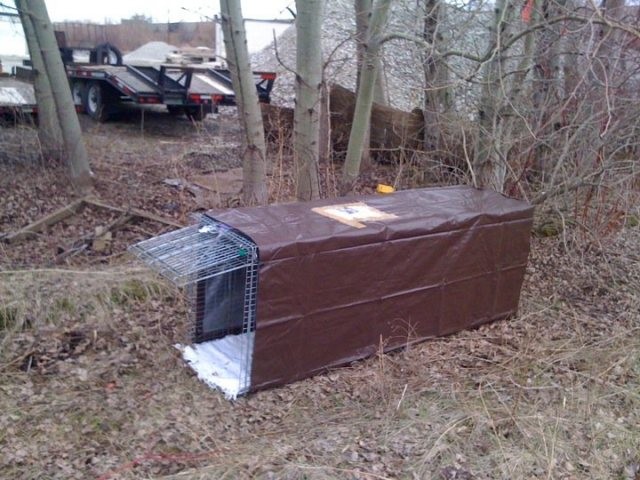
As soon as Jill got off work, she raced to Meg’s home. She searched the three-and-a-half acres to no avail. Fred came out later with Zuess to use him as a lure, but that didn’t work. Fred decided they weren’t going to capture Rocky without a cage. They went home and rigged one with boards and wire that would trigger and trap Rocky if he walked in. At dusk, they went back to the woods to set it up, baiting the trap with toys and a blanket from home as well as food. It started to rain, and before they turned to leave, Jill saw Rocky in the distance. She knew this method was going to work.

Saturday morning Jill and Fred drove back to the woods to check the trap, and sadly, Rocky wasn’t in it. It had been almost four weeks since losing him and this was the closest they’d been, so there was no way they would stop trying. They checked in on the trap periodically all weekend. Finally, at 8am Sunday morning Meg called to deliver the news they had been so desperately waiting for. They caught Rocky in the cage. “Like a crazy person, I drive out there and sure enough, there was my Rocky!” remembers Jill. “[He] was soaked to the bone, dirty, and a mess, but very happy to see his mommy.”

The Grovers immediately took the much skinnier dog to the family vet. He had lost 20 lbs, had sores on his paws and was covered in ticks; all expected from a month in the wild. He is now on medications and his progress will continue to be followed by the vet. With time and much-needed attention from his family, they expect a full recovery. Rocky is finally reunited with his brother Zuess and bathed back to his bright white coat.

All throughout the month-long emotional rollercoaster, the Grovers never ever stopped trying to find Rocky. The long days and nights were worth it and their hard work paid off. Jill is very happy to report, “We are a happy family again!”

How To Approach Your Dog When He/She Is Lost..

Even though your dog, Snickers, has only been missing for three days, you are worried you’ll never see her again. You promise yourself you’ll never get another dog because, obviously, you can’t be trusted. You are wondering why, WHY DID YOU ASK THE NEIGHBOR’S TEENAGER TO WALK SNICKERS WHILE YOU WERE ON VACATION? And why, why did the kid decide to go jogging with Snickers without putting her leash on? You are worried about the kid’s generation being able to lead the country while you are in your retirement years when you suddenly see a familiar shape three yards over from yours. You recognize her instantly – it’s Snickers!

You are tempted to run out of the door and call her to you, but you resist that temptation when you see her run from the neighbor’s children…children Snickers has always loved playing with. What if she runs from you, too? Could she have forgotten the family, the community that loves her after only three days? Now what?

Well, if your dog is lost and you see her, you are 100% right to pause, collect yourself, and, above all, calm yourself down. You’ll be excited to see your dog, of course, but your dog may be equally anxious to protect herself from what she perceives to be threats, including you. And, she may run as far away from you as possible.

If she does, make sure you are prepared for the next time you see your pet. Load your car with non-perishable goodies and toys she normally enjoys so you can use them to lure your dog to you the next time you see her. Make sure you have enough goodies…it may take quite a few treats to convince your dog to come to you. Make sure you always have a leash at your disposal and a spare collar as well in case your dog has lost hers during her travels.
When you arrive at the scene of where your dog was most recently seen, remain calm…and quiet. Don’t honk your car’s horn, slam its doors, or start yelling your dog’s name. Simply arrive and let your dog get used to you being in the vicinity of her. Talk to her quietly, using words and phrases that remind her of the comfort and happiness you’ve given her throughout her life. Say things like, “Wanna go for a walk?” Or, “It’s dinnertime!”

Remember to be patient as you literally inch closer and closer to your dog and pay close attention to the clues your pet is giving you about your approach. If your dog braces as if she’s preparing to run away, stop moving and lower yourself to the ground. When your dog is calm again, try to get a bit closer to her by walking slowly in a sideways direction with your arms at your sides. Use your lips to smile, not your teeth, so your dog doesn’t think you are growling at her. Also, don’t look directly at your dog or stare at her as a predator would.

As you are getting close enough to your dog to use the treats you brought to lure her to you, assume a submissive position by getting as close to the ground as possible as you continue your advance – consider crawling, if necessary. By doing this and using positive tones when you speak to your pet, you will demonstrate that you are not a threat to her well-being. When you’re within throwing distance, your pet will be able to see and smell the food you’ve brought for her.

Gently and slowly toss some treats off to the side of your dog without hitting her. Hold your eyes closed and move your head down and off to the side to show your dog that you are not going to challenge her for the food. Do this repeatedly until your dog is comfortable with your proximity to her.

When your dog has finished the first round of treats, throw a few more, but make sure they land farther from her and closer to you. Give your dog praise with every step she takes closer to you, even if it’s only to get some food. Pretend you are eating some of the treats you still have at the ready, too. Lick your lips and tell your dog how good the treats are…and ask her if she wants some more.

When your dog is finally close enough to you for you to grab, you will have to make a choice about how to secure your pet. You can offer more treats in one hand while attaching a leash to your dog’s collar with your other one. Or, you can grab your pet’s collar, quickly taking in any slack. Or, you can rub your dog’s muzzle while attaching her leash to her collar.

If your dog’s collar is no longer around her neck, put the end of her leash through the wrist loop at the top, and loop the end of the leach around your wrist several times while holding it securely in your hand. The leash will act as a slip lead and tighten once it’s around your dog’s neck.

If you’re dog hasn’t been seen, but you know where your dog is likely to be while she is lost, find a spot in the vicinity where you can wait with some treats and her favorite toys. When you hear your dog coming, put out some treats that will lead her to you.

If you have people who are helping you find your dog, make sure they don’t distract her while you are trying to lure her to you. Your dog should be focused on you and you alone. Instruct your helpers to assume discreet positions that will enable them to see where your dog was going in case she runs away from you. Make sure you give your friends and family members enough treats for them to try to lure your pet to them in case she gets close enough to their positions.

If a dog is new to your family, whether you’ve just taken in a foster or adopted an unfamiliar dog, help your new pet to start trusting you and to learn your unique scent by putting food and water out in the same location every single day she is lost. Talk to the dog, address her by name even if it’s a new one. Try to bond with your dog even if you can’t see her. If you are consistent with your efforts, it’s likely your dog will eventually get close enough to you for you to bring her back to the home she may only be seeing for the first time!

Our tips, ideas and articles are based on information gathered from over 3000 successful lost dog recoveries. Any advice or suggestions made by Lost Dogs of Wisconsin/Lost Dogs Illinois is not paid-for professional advice and should be taken at owner’s discretion.

Is Your Missing Dog Caught in a Custody Dispute?

file7501315752170


At Lost Dogs Illinois we concentrate our efforts to help the individual owners and finders of lost dogs.  Our page and website can give good advice and support for both shy and friendly lost dogs.  They can also give you excellent advice if you have found a loose dog and are looking for the owner. Along with our sister organizations we have helped successfully reunite thousands of dogs.

Some times, a missing dog becomes involved in a custody dispute.  The dog has been located, but for whatever reason, is not in the possession of the owner.  This is generally beyond our parameters of our mission or scope of  our services.

We can offer some advice though – that may be helpful if you find yourself in this situation.

Who might have the dog?

  1. A disgruntled spouse, boyfriend or girlfriend, or family member.
  2. A disgruntled employee.
  3. A disgruntled contractor who believes that money is owed for services provided.
  4. A Good Samaritan who picked the dog up and has now become emotionally attached to the dog, or believed that the dog was neglected, abused or abandoned.
  5. An adopter who unknowingly adopted your lost dog from a shelter or rescue.

Here are our five suggestions if you are having trouble regaining custody of your dog:

  1. Immediately contact your local police department and file a police report. Dogs are property in all fifty states and somebody has possession of your property. Even if the police don’t appear helpful, this paper trail will help you if you have to go to court.
  2. Heavily flyer the neighborhood AND the house where your dog is located. Some finders will turn the dog over either because they feel guilty or are afraid of getting in trouble with the law.
  3. Gather and organize all of your paperwork that proves ownership of your dog including adoption or sale papers, vet records, microchip information, family photographs and dog licensing records.
  4. Consider hiring an attorney and/or a private investigator to help you.
  5. Contact your local media to see if they will consider doing a story about your missing dog and your situation.

A few more tips:

Stay calm. The police will be more likely to help if you remain calm and rational.

Be smart and safe.  Never arrange to meet anybody alone. Choose a neutral safe place to meet, perhaps the parking lot of the police station, and preferably during daylight hours. Better yet, ask the police to accompany you.

If you feel that you are being scammed – please click this link and read this article.

Don’t give up! Custody suits can take weeks, months or longer to pursue.  Your dog is depending on you to bring him safely home.

Our Response to Media Hype about “Dog Flipping and Dog Thefts”

dogstreetIn the last two and a half years, Lost Dogs Illinois and Lost Dogs of Wisconsin have reunited almost 10,000 dogs with their owners. The vast majority of these dogs are either simply lost; or they have been picked up by a Good Samaritan.

A picked up dog is one that was lost or perceived to be lost and a Good Samaritan took the dog to keep it out of harm’s way. The Good Samaritan means well but human behavior comes in to play and several false assumptions may be made. They often assume the dog has been “dumped” because it appears matted, dirty or hungry (all of which can be attributed to being lost, even for a very short time). The Good Samaritan may then take one of these courses of action:

1. They become emotionally attached to the dog and keep or rehome the dog themselves.
2. They take the dog to a shelter or vet clinic that is not the official stray holding facility for the area – either because they don’t know which is the correct facility or they have heard rumors that it is not a good facility and they want to take the dog somewhere “better”.
3. They play the “wait and see game” to see if flyers and signs are posted; because this convinces them that the owner truly wants their dog back.

Dog theft is something entirely different because the motivation is different. Stealing involves a person who commits a crime of intent by illegally entering your house, yard or vehicle and taking your dog. “Stolen” dogs make headlines which makes it appear that it happens more often than it does. But when the dog is recovered, and it wasn’t stolen; the outcome doesn’t get the same media attention. So the public only remembers that the dog was “stolen” when it may have simply been lost or picked up. The media loves to over-sensationalize the story of a stolen dog or “dog flipping”.

At LDI/LDOW we focus on “probability” vs. “possibility”. We never say never, but when we look at the results of our 9000 plus successful reunions, we see some pretty clear patterns. In our experience very few dogs are actually stolen for profit or bad intentions. And of those that are stolen, many of those have been taken by somebody that is known to the family:

1. A disgruntled spouse or family member

2. A disgruntled employee, contractor or debtor

3. An unhappy neighbor or animal welfare advocate who disagrees with how the dog is cared for.

The American Kennel Club press release that stated that “dog theft was on the rise” was based on figures that stated they had an increase in “stolen” dog reports from 432 pet thefts in 2011, compared to 255 thefts in 2010.   This is an increase of  177 dogs but of course they expressed that as a percentage and the headlines screamed: “Dognapping Cases Are Up By Almost 70 Percent!”   Now compare those figures to how many dogs are owned in the USA – almost 80 million dogs.

The current stories circulating about “dog flipping” are based on a few incidences and  are not indicative of a new pattern or “trend”.

Instead of over-sensationalizing dog theft and “dog flipping”; at LDI/LDOW we focus our efforts on educating owners how to successfully find their dogs no matter what the circumstances; and teaching Good Samaritans how to correctly reunite found dogs with their owners.

Thank you for helping us in our mission. Together we can help more lost dogs get home!

If you truly believe your dog has been stolen please read this article for further inform